
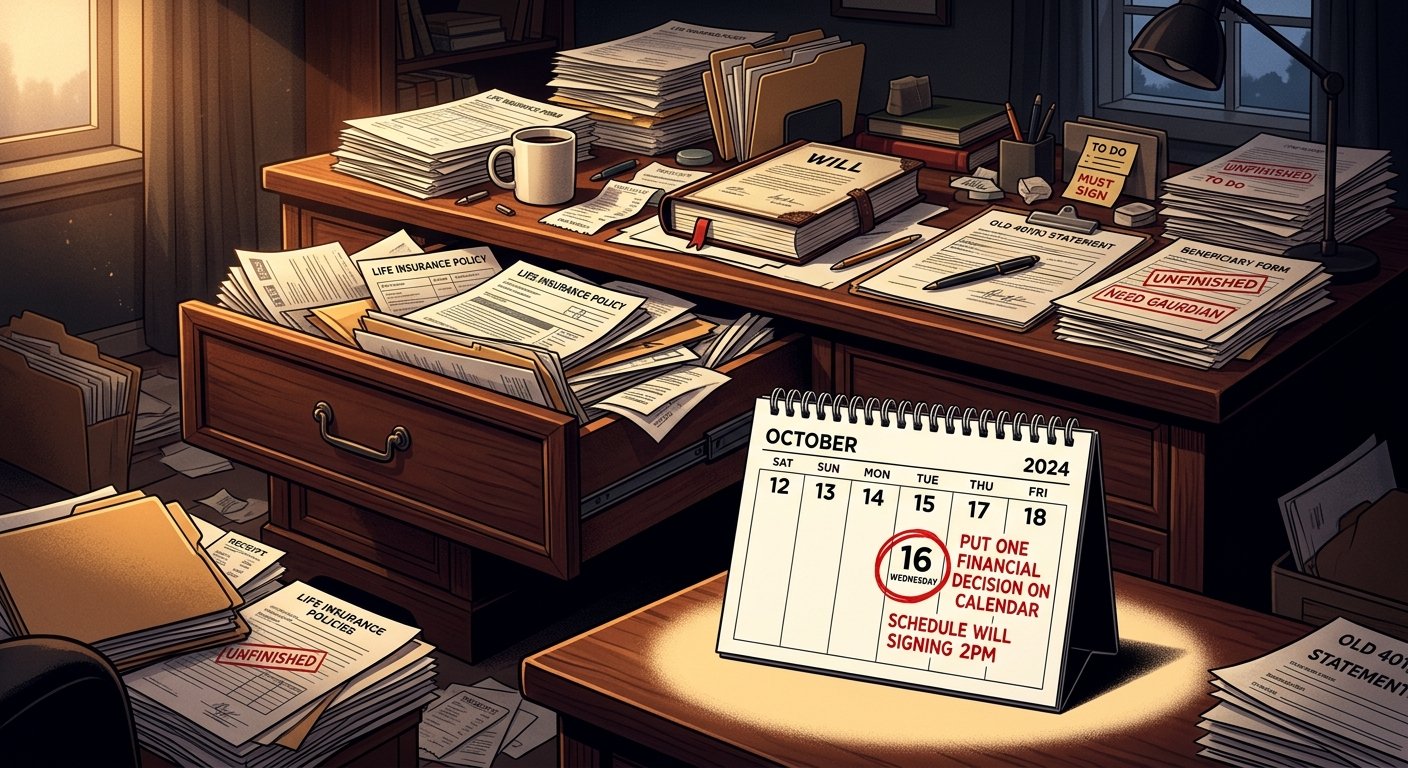
Planning season kicks off in the early fall for me, so most of September and October I am across the table from families walking back through their year. And almost every time, the same moment arrives. We reach the part of the list that was on the list last year, too. The estate documents nobody has signed. The beneficiary form from a job someone left three employers ago. The old 401(k) still sitting exactly where it landed the week they were hired. Everyone at the table knows it is there. Nobody has touched it.
I used to think these things waited because people did not understand them. That one more explanation of why a will matters, or how a beneficiary designation works, would finally move it. It rarely does. The families I work with understand these decisions fine. They are sharp people running complicated lives. What the undone items have in common is that they are quieter than knowledge, and once you see it, you cannot unsee it. None of them has a deadline. Nothing forces the day.
That is the whole piece, so let me say it plainly. In a busy household, the financial decisions that quietly compound are the ones with no forcing function behind them.
The bill that never gets missed
Look at what does get done, without effort, month after month. The mortgage clears on the first. The car payment. The utilities. The three subscriptions nobody remembers signing up for. All handled. Not because those are the important ones. Because each of them has a date attached and a machine standing behind it.
Now look at what waits. Updating a beneficiary after a divorce or a new baby. Rolling two old accounts into something you actually watch. Getting the will and the powers of attorney signed. Naming a guardian for the kids. Deciding what to do with the concentrated stock position that has been building through years of grants. Not one of those sends a reminder. Not one auto-drafts. They sit in the same drawer, year after year, and the drawer gets heavier.
I run into a pattern regularly. Two above-average incomes, a few kids, both parents in high-level careers whose calendars belong to other people. They had done the hard part. They saved. They drew up a plan years ago. And the beneficiary on the largest account still named someone from a decade earlier, a name the form had outlived. Nobody failed here. The account was self-directed, set once at onboarding, and it had no reason ever to come back up. Absence of oversight is not the same as carelessness. It is what happens to any decision that never gets scheduled.
Build the deadline yourself
Before either move, there is usually a smaller one: rule things out. Part of what makes the pile feel immovable is that every option is still open at once, and a long menu is harder to act on than a short one. Most of the list is not actually urgent. When you cross off everything that can genuinely wait until next quarter, what remains is short enough to look at without flinching. That shorter list is what the next two moves are for.
The first move is automation. If a decision doesn't have to be remembered, it stops competing for your attention at the end of a long day, which is when most of these get looked at. The contribution that moves on its own. The transfer into the reserve that happens before anyone sees the money. Dr. Jennifer Dragonette, on the podcast recently, put it plainly: anytime you can make something not have to be remembered, you have taken weight off. Out of sight, out of mind is usually a warning. Pointed at the right task, it is the entire solution.
The second move is scheduling the single next step, not the whole project. This is where most people quietly lose. The task in your head is to get our financial life in order, and that is not a task. It is a category, and nobody can do a category. What you can do is book one meeting. Pull one form up on the screen. Send one email to the attorney you have been meaning to call since spring. Jen has a way of describing the trap underneath this. Held as one aggregate, the thing is too big for your brain to process, so it shuts the whole file. Broken into the next right step, each piece usually moves faster than you expect.
A harder truth is folded into that, and it is worth sitting with for a second. Not deciding is itself a decision. Leaving the beneficiary as it is, is choosing to keep it as it is. That can sound like a scold. It lands more like relief. The moment the thing you have been avoiding is back in your own hands as a choice you are actively making, rather than a vague weight you are carrying, it tends to get made.
Why two careers make it heavier
None of this is hard in isolation. The individual pieces are not the problem, and pretending they are is how our industry talks people into believing they need us for the wrong reasons. The coordination is the problem.
In a two-career house, both calendars are full, both careers are senior enough to be pulled ten directions before lunch, and one partner has usually drifted into owning the money by default. Not because they volunteered. Because someone had to, and neither of them has a free afternoon to sit down together and work through a list that never had a due date. So the list stays a list. The competence was never in question. The missing ingredient is the one shared hour nobody can find, repeated across a dozen small decisions until the pile looks like a personality flaw instead of a scheduling problem.
I will say the quiet part about myself too, because this is not a lecture from someone who has it solved. I have my own version of that drawer. A couple of decisions I have carried for longer than I would put in writing, for exactly the reasons I just described. Same failure mode. Different account.
The one thing to do this month
A hard stretch has a way of turning the estate conversation from someday into now. When you have watched, up close, what an unsigned document or an outdated form does to the people left holding it, the drawer stops being abstract. I have felt that this year, and it has changed how fast I want these done, for the families I work with and for my own house.
So do not try to fix the whole picture this month. Pick the one decision that has sat on your list the longest, the one with no date anywhere near it. Write it down where you will see it tomorrow. Then do exactly one thing. Book the meeting that starts it, or set the automatic transfer that ends it. Give that single decision a deadline it was never going to get on its own. The rest of the drawer will still be there next month. It will just be one item lighter.