
What Breaks When One Spouse Handles the Money
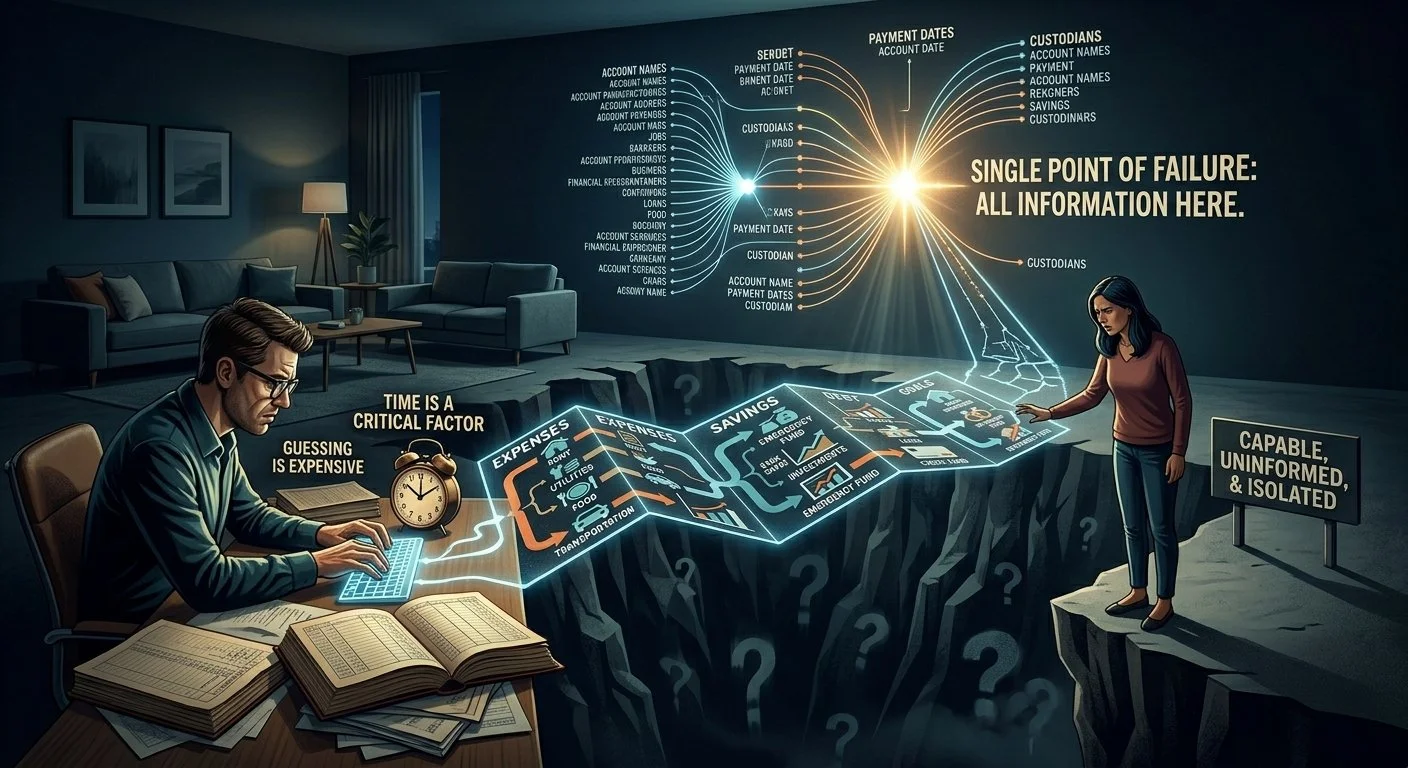
I spent an hour last week building a single page for a family I work with. Not a plan. Not a portfolio review. One page.
Every account. Every automatic payment and the day it clears. The one folder with the tax documents. The one folder where the estate documents actually live. That was the entire project, and it was one of the more useful hours I've spent with a client all year.
The partner who runs their money has run it for two decades. Careful, and good at it. About forty minutes in, she said the quiet part out loud: if something happened to her, her husband wouldn't know where to start. She wasn't being dramatic. She was being precise.
I hear a version of that a lot with families I have initial conversations with. One person owns the money. Not by decision, by default. The other is fully capable and has simply never needed to know.
Driving home, it landed on me that I am that person in my own house. Theresa is sharp, sharper than me on plenty of things, but if you asked her tonight which accounts pay which bills, or who to call first, she would be guessing. I build this page for other families. I have a quasi-built version for mine.
The failure that never sends an alert
I thought about an idea which is, destruction is driven by single points of failure, the kind that can happen in seconds, while growth compounds so slowly you barely feel it. The failures are loud. The growth is quiet. So we spend our attention on the loud thing and almost none on the quiet one.
A household where one person holds the entire financial picture is a single point of failure. A clean one. And it survives for years because it never behaves like one. A market drop shows up the same day you feel it. Your whole financial life living inside one person's head drops nothing, sends nothing, demands nothing. It runs perfectly, right up until the stretch of time when it can't, and by then you are not maintaining a system. You are trying to rebuild one from the outside.
That is the part worth sitting with. The risk is not that the person running the money is bad at it. In these families, they are usually very good at it. The risk is that competence in one person looks exactly like resilience across two, right up until the day you need the second person and find out they are not the same thing.
Why capable people still get caught
The most common objection is also the most reasonable one. We are both smart. We would figure it out.
On a normal Tuesday, that is true. Under a deadline, with no map, at eleven at night when a payment has to move, and you do not know which of four accounts it comes from, it is not. Capable under normal conditions and capable under pressure with no information are two different states, and the gap between them is exactly where the damage lands. It lands fast, which is the whole point. Nobody rises to a system they have never seen. They fall back on guessing, and guessing with real money against a clock is how a small problem becomes expensive.
Look at what is actually on that page, and you will see why it never gets built. None of it is hard. That is the trap. Which account covers the mortgage on the first? The login to the line of credit. The one college account sitting at a different custodian than the other two, because it got opened in a hurry the year a kid was born. The coverage through work nobody has read since the day it was set up. The insurance agent’s cell number that lives in exactly one phone.
Every piece is simple. The coordination is what nobody has the hours for. And the reason nobody has the hours is that not one item on that list has ever produced a deadline. Nothing forces it. So it waits, quietly, for years, while everyone assumes that because the money is handled, the household is covered. Those are not the same thing.
The two-week test
Here is a way to find your own single points of failure without waiting for the event that exposes them. Run a two-week test in your head. If one of you were completely unavailable for two weeks, not gone, just underwater, in a hospital bed or on the far side of some crisis, could the other one keep the household's money running?
Not manage it well. Just keep it from breaking. Could they pay what needs paying, find what needs finding, and reach who needs reaching without one phone call to the person who is unavailable?
For most dual-income families, the honest answer is no, and it has nothing to do with intelligence or effort. It is structural. The information never got written down anywhere, but one person's memory, and memory is not a system.
When I sit with families in the middle of a real transition, a job loss, a death in the extended family, a health event, the ones who come through it steady are rarely the ones with the best returns. They are the ones where a second person could see the whole board. Coordination is the thing that holds when everything else is moving. It is also the hardest thing to value, because when it is working, nothing happens, and nothing happening is a strange thing to feel grateful for until the one time it saves you.
One hour, one page
So build the page. Open a blank document and put four things on it. Every account and how to log in. Every automatic payment and the date it hits. Every professional you pay, with a name and a number. And the one place the estate documents live. Then hand it to the other person, out loud, this week.
It will take about an hour, and it will not be elegant, and it does not need to be. The entire point is that it exists somewhere other than one person's head. It is the least glamorous hour in your whole financial life. Nothing to report, no number that moves, nothing to feel good about afterward. It simply turns one point of failure into two, which is the only move that makes a household genuinely hard to break.
The growth in your financial life will keep compounding in the background, where you cannot feel it. That part mostly takes care of itself if you leave it alone. The thing that can undo it in a single bad stretch is the part no one is looking at, precisely because it has never once asked to be looked at. An hour and a page is a strange defense against something that size. It is also the one that works.