
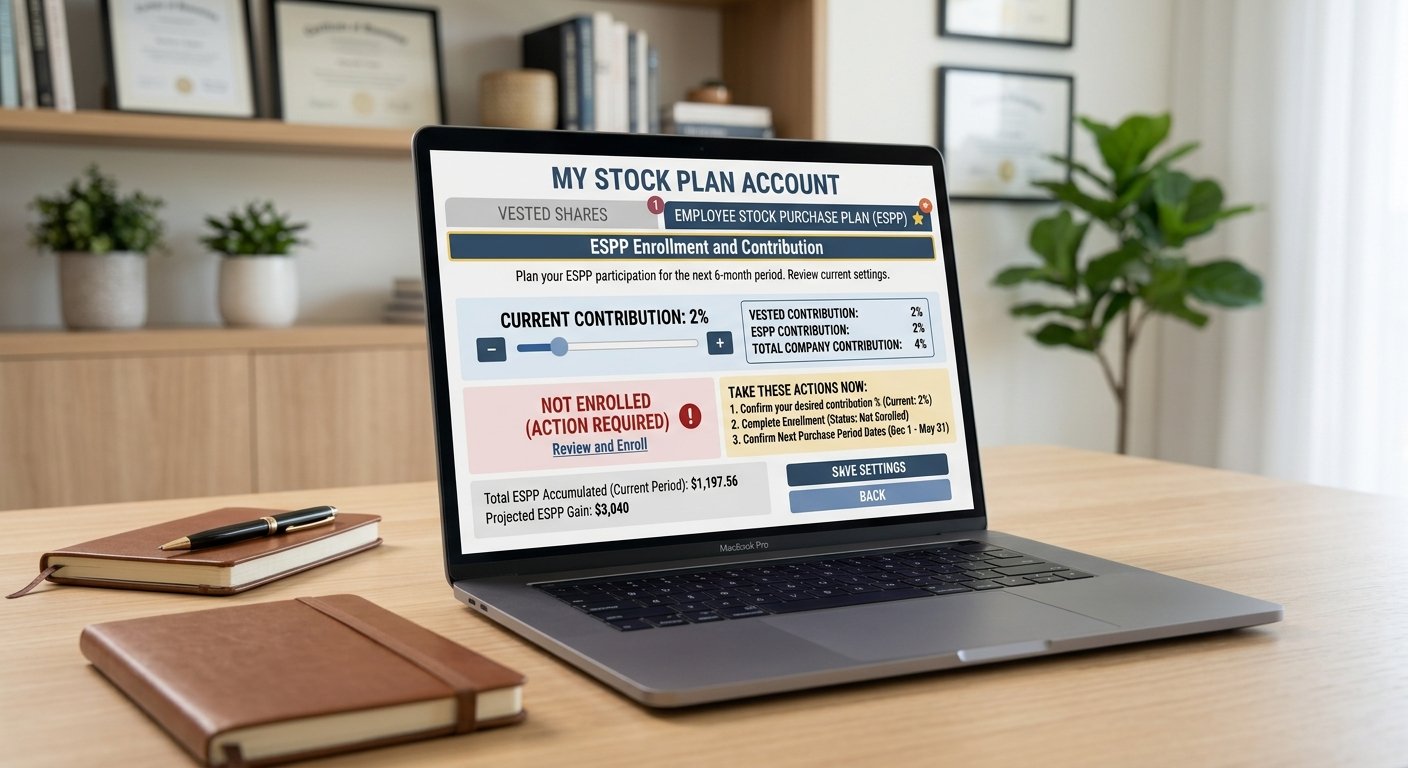
Every company stock plan site has two tabs that sit next to each other. One shows the shares that have vested. People know that tab well, and they check it after a strong earnings call and avoid it after a weak one.
The tab beside it gets far fewer visits. It holds the employee stock purchase plan, and in the families I work with, I usually find it set one of two ways.
Sometimes there is a contribution of one or two percent of pay, picked during a first week on the job in the same sitting as the dental plan. Three promotions later, it has never moved.
More often there is nothing at all. The family never enrolled, and when I ask why, I hear a version of the same sentence. We already own enough of the company.
I understand that sentence. I have written before about the household where the salary, the bonus, the health coverage, and the largest holding all trace back to one employer. Wanting less of that is a sound instinct.
It also answers a question the purchase plan never asked.
How the Discount Works
Most employee stock purchase plans run the same way, though the details differ by company, so check yours. You choose a percent of your pay. That money comes out of each paycheck after tax and is collected for a set stretch, often six months.
At the end of the stretch, the plan uses what has built up to buy company shares for you at a discount. Under the rules these plans follow, that discount can be as much as fifteen percent.
Many plans add a feature called a lookback. The plan compares the share price on the first day of the period with the price on the purchase day, takes whichever is lower, and applies the discount to that lower price.
Numbers make this easier to see. These are invented to show the arithmetic, and they are not drawn from any company.
Say the stock sat at forty dollars when the period opened and fifty on the purchase day. The plan uses forty. Fifteen percent off forty is thirty-four, so you pay thirty-four dollars for a share trading at fifty that afternoon.
And if the price had gone nowhere, you would still have paid thirty-four for something worth forty. That gap exists on the purchase date. It is there before anyone decides whether to hold the shares for ten years or ten minutes.
It also helps to be honest about how long the money is tied up. The first paycheck's contribution waits the full period, and the last one waits a few days. On average, a dollar sits in the plan for about half the stretch before it buys anything.
None of this is a promise. The price can fall between purchase and sale, and a sharp enough drop can erase the discount.
Some senior employees can only sell during set windows. Those limits are real, and they belong in the decision.
Two Decisions on the Same Screen
This is where the sentence about owning enough of the company falls apart. Enrolling in the plan and keeping the shares are two decisions. They happen on different days and address different things.
The first is whether to take the discount. That is a question about the paycheck, because money going into the plan is money that does not reach the checking account for months.
For a family already stretched between a mortgage, three kids in activities, and two retirement plans, that is a real cost. For some families it is the right reason to enroll at a modest percent, or to wait.
The second is whether to keep the shares once they land. That is a question about how much of a family's future rides on one company. It deserves a deliberate answer, and the answer may well be that the family holds plenty already.
The trouble starts when the second answer gets used for the first question. A family can take the discount and still decide not to add to the position. One does not commit you to the other.
Skipping the plan over a worry about concentration gives up the first decision without ever making the second.
The Part You Control
"Learning how to live with less is one of the most powerful financial levers, because you have more control over it than things like your income or investment returns."
That line is from Morgan Housel, and he was writing about spending. The test inside that sentence applies here as well. What do you control?
Nobody controls where a share price goes next year, including the people who run the company. I do not forecast it for the families I work with.
The percent on the enrollment screen is different. That is a number the household sets, and so is the choice to look at it once a year.
In most conversations I have about company stock, nearly all the attention goes to the part nobody can control. Almost none goes to the one setting that sits entirely in the family's hands.
Where the Tax Gets Counted Twice
The tax side is simpler than its reputation. Nothing is owed when the plan buys the shares. Tax comes due when they are sold.
At that point, the discount is treated like pay and taxed as ordinary income, same as your salary. Whatever is left over is a gain or a loss on the stock, and how long the shares were held changes how it is taxed.
Here is what catches people. The form a brokerage sends at tax time often lists what was paid for the shares without adding back the discount that was already counted as pay.
If nobody adjusts for that, the same dollars are taxed twice, once as income and once as a gain.
I have seen it on returns. Nobody made an error in the usual sense. One document came from the employer, another came from the brokerage, and no one read the two together.
The amount on any one sale is usually small. That is part of why it survives, year after year, without anyone catching it.
The employer also sends a separate form listing the dates and prices for each purchase. It settles the question, and it is easy to set aside without opening.
That is the pattern underneath the whole subject. No single piece of a stock purchase plan is hard, and a capable person can work through every part in an evening. What these families lack is the evening.
Three Facts Before Anything Changes
So start smaller than a decision. Log in to the stock plan site and find the purchase plan tab.
Write down three things: the date the next enrollment window closes, the discount the plan offers and whether it has a lookback, and the percent elected today, even if that number is zero. If both spouses have a plan, do it for each.
That takes about five minutes, and nothing has to change yet. What changes is that you can now make the first decision on its own terms, with the deadline and the discount in front of you.
Most of what a senior professional is paid arrives without a choice attached. The salary shows up. The shares vest on a schedule somebody else wrote.
The purchase plan is one of the few places where the company asks what you want and waits for an answer. It is worth giving one on purpose.