
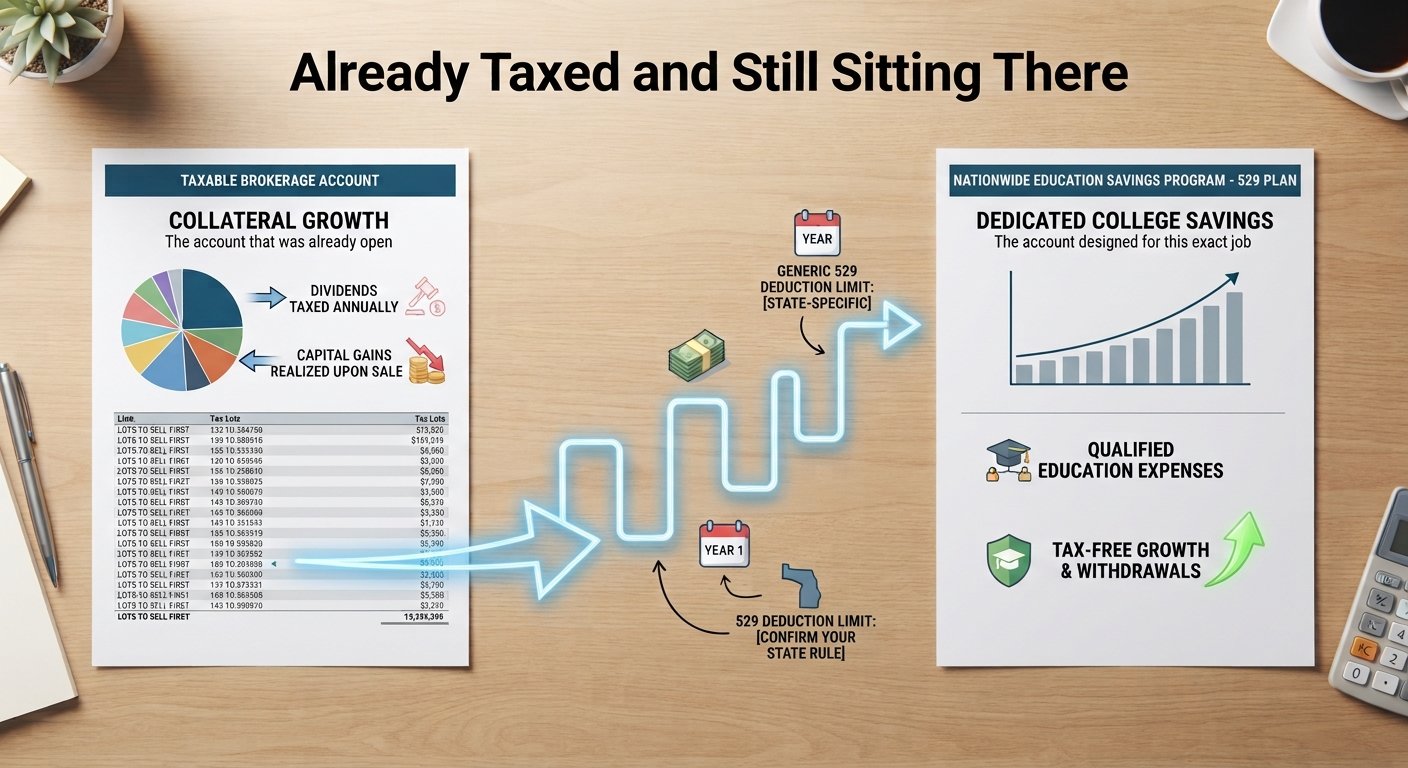
Most of the families I sit with have an account they call the college account. When they pull it up, it is almost never a 529. It is a regular brokerage account, opened years ago with a bonus or a block of vested shares that nobody wanted to spend.
Somewhere along the way, the two of them started calling it college money, and the name stuck. They meant it. In most cases, nobody has touched it for anything else in years.
I had that conversation again this week, and I asked the question I always ask. If this money only has one job, why is it sitting in an account that taxes it like it could do anything?
The account that was already open
A brokerage account taxes the money inside it as it goes. Dividends are taxed in the year they are paid. Fund distributions are taxed in the year they land, whether anyone sold anything or not. And when the family finally sells to pay a tuition bill, the growth is taxed then too.
None of that is a mistake. A brokerage account is built to be flexible. It can fund a kitchen, a car, a gap between jobs, or a down payment, and the tax treatment reflects that. It does not know that this particular balance was promised to a freshman dorm in three years.
In a two-career household, the account usually grew from both sides. One spouse's bonus went in one year. The other spouse's vested shares got transferred in the next. Each deposit made sense when it happened, and nobody ever stepped back to ask where the total should live.
Meanwhile, the account designed for this exact job usually sits right next to it, with a small balance or none at all. Nobody chose that arrangement. The brokerage account was the one already open when the bonus arrived, and money tends to stay wherever it first lands.
This is what coordination failure looks like in practice. Nobody did anything wrong. The decision about where college money should live simply never got made, because the label made it feel like it already had been.
What the 529 adds, and what it asks in return
In Michigan, and in many other states, what you contribute to the state's 529 plan comes off your state taxable income, up to a limit. That limit resets every year. In Michigan, a year you skip does not roll forward. Some states handle carryforward differently, so the rule in your state is worth confirming before you plan around it.
Inside the 529, growth isn't taxed along the way, and it comes out tax-free when you use it for qualified education costs. That is a real difference from the brokerage account, where every dividend and distribution generates a tax line every year.
The 529 does ask for something in return. If the money is used for something other than school, the growth is taxed, a penalty applies, and Michigan recaptures the deduction. That is the trade. For a family that has already committed to college in every way except the paperwork, it is usually an easy one to accept.
Morgan Housel once passed along a line from Peter Kaufman that I keep coming back to here. "We tend to take every precaution to safeguard our material possessions because we know what they cost. But at the same time we neglect things which are much more precious because they don't come with price tags attached." Kaufman goes on to say the value of those things stays hidden because no money changes hands.
An unused deduction is exactly that kind of thing. No money changes hands. Nothing appears on a statement. Nobody gets a letter saying a deduction expired. The year closes, the account keeps its name, and the family never feels the miss.
Where the tax actually shows up
The obvious next move is to sell the whole brokerage account and push it into the 529 in one shot. I understand the appeal. It feels decisive. But selling is where the tax shows up, and selling everything at once is usually the clumsiest way to do it.
Every share in that account carries a gain or a loss. Sell the shares that have doubled, and the family creates a sizable taxable gain this year to fund an account whose state deduction is capped. The tax created by the sale can easily outrun the deduction the contribution earns.
So the order matters more than the amount. Shares that came from a recent vest usually carry very little gain, because the tax was handled when they vested, and the cost basis starts at that day's price. Shares bought near a market high may carry almost no gain, or a loss. Those are the first to move.
In a household with two sets of equity compensation, this sorting is rarely done. Shares from two employers, vesting on two calendars, often sit in the same account with dozens of lots and very different cost bases. The statement shows one total. The tax picture underneath it is anything but uniform.
The shares with large gains can wait. Some may never need to move at all. When a tuition bill arrives, they can be sold to pay it directly, and the family can decide in that year whether the gain is worth taking. That is a decision for a specific year, made with that year's numbers in front of it, not a decision forced by a reorganization done in a hurry.
Every year, from the bottom of the list
The pattern that works is quiet and repetitive. Each year, the family moves enough from the brokerage account to fill that year's state deduction, starting with the lowest-gain shares. The deduction gets used. The gains stay small. And over a few years, more of the college money ends up in the account designed to hold it.
There is a fair argument for moving more than the deduction amount, so more of the balance grows inside the 529 sooner. Whether that makes sense depends on how old the kids are, how large the gains are, and what else is happening on that year's return. With a high schooler, growth inside the 529 has only a few years to work, so the case for moving extra is weaker. The deduction still counts in every one of those years. It is a judgment call, and it is one worth making on purpose. The floor is not a judgment call. At a minimum, fill each year's deduction.
Here is the step. Log into the brokerage account you call college money and find the cost basis screen. Your custodian may call it lots or unrealized gains. Write down the three lots with the smallest gain. Next to them, write the dollar amount it would take to fill this year's state 529 deduction.
That page answers two questions most families have never put side by side: what to sell, and how much. It takes about ten minutes, and it turns a label into a decision before the year closes.
The families who call that account college money have already done the hard part. They decided what the money is for. What is left is giving it a home that matches the job, a little at a time, in the order that costs the least to get there.