
Your Company Stock Decision Will Look Wrong for a While. That’s Not the Problem
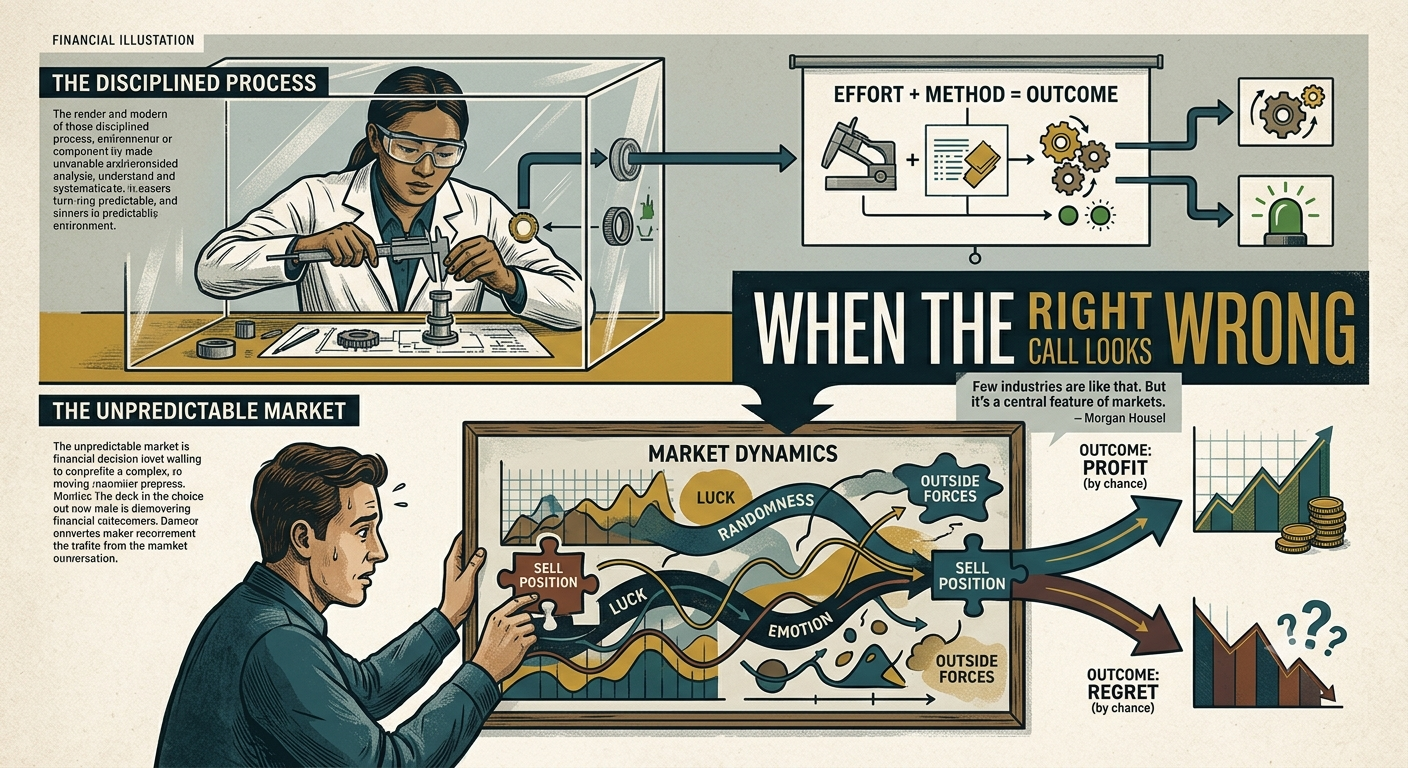
Most of the hardest money decisions I help families with don’t have a clean right answer. They have two reasonable answers, and each one will look wrong for a stretch of time. You don’t find out which until later, and by then it feels personal.
The clearest example I run into is company stock.
If you’ve spent your career climbing into senior roles, there’s a good chance a real piece of your net worth is sitting in your employer’s stock. Maybe it’s shares that vested over the years. Maybe it’s options. Maybe you just kept it because the company has been good to you, and holding felt like a vote of confidence. However it happened, one position quietly grew into a large share of everything you own.
At some point, a planning conversation turns to trimming it and selling some of it down so your family’s future doesn’t ride on one company’s next few quarters. And this is where the decision gets hard, because no version of it feels clean.
The decision isn’t really about the stock
Here’s the part most people get backwards. The decision to hold or sell company stock has very little to do with the stock. It has to do with your family.
The first question I work through with families isn’t where the stock is going. Nobody knows that, including the people who run the company. The question is how much of your future is currently riding on a single business?
When a large piece of your investments sits in your employer, you have doubled down in a way that’s easy to miss. Your income depends on that company. Your net worth depends on that company. A bad stretch for the business can hit your paycheck and your portfolio in the same year, exactly when you can least afford it. That’s the real exposure, and it has nothing to do with whether it’s a “good company.”
A test I find useful is simple. If you had the cash sitting in your account today, would you go out and buy this much of this one stock? For most families, the honest answer is no. They’d never choose to put that share of their net worth into a single name. But because it arrived as compensation, it doesn’t feel like a choice they made. It feels like something they’d be giving up. That framing is worth noticing, because holding is a decision too. Doing nothing is a bet, just a quieter one.
From there, the decision is built around a handful of things that are actually about you, not about the market. How much of your wealth is in this one position? What do the rest of your assets look like? How many years until you need the money? What does the tax picture look like if you sell, and over how many years you’d want to spread it out? Whether there are blackout windows or trading restrictions, you have to plan around them. Whether selling some of it now is designed to protect a future that matters more than the upside you might be giving up.
Notice what’s not on that list: a prediction about the stock price. That’s on purpose. A plan built around predicting the price is just a guess wearing a suit. A plan built around your family’s actual needs is something you can stand behind no matter what the price does.
A good decision and a good outcome aren’t the same thing
If you trim the position to protect your family, and the stock climbs for two years, you will be able to calculate the exact amount you “left on the table.” It will feel like a mistake. It wasn’t. You lowered the chance that one company could derail your family’s plans, and that was the right call regardless of what the stock did afterward.
If you hold the position because selling felt like betting against your own team, and then a rough quarter takes a chunk out of it, holding will feel reckless in hindsight. But if the holding was sized correctly for your situation and made with clear eyes, it was a reasonable decision that resulted in an unkind outcome.
This is the distinction almost nobody applies to their own money. A good decision and a good outcome are not the same thing. You control the decision. You do not control the outcome. You never did.
Why this lands harder if you came from engineering or medicine
Here’s why this matters more for the families I work with than for most people. If you built your career in engineering, operations, medicine, or manufacturing, you spent decades in a world where good process produces good results. You run the analysis, you follow the protocol, you do the work, and the outcome often follows, so you come to trust it. That trust is exactly what made you good at your job.
Markets don’t honor that deal. In markets, a careful, well-reasoned decision can look bad for years, and a careless one can look brilliant. The scoreboard is loud, specific, and frequently lies to you about whether you played well. And it slowly teaches the wrong lesson, which is what makes it dangerous.
If selling looked like a mistake because the stock ran, you’ll hold the next position too long. If holding burned you, you’ll sell the next one at the worst possible moment. Grading yourself on outcomes is how thoughtful people talk themselves into a worse plan, one reasonable-sounding regret at a time.
The reason this is so hard isn’t the math. The math is the easy part. It’s that we are wired to judge ourselves by the scoreboard, and a single stock gives you the most precise, most punishing scoreboard there is. You can calculate your “mistake” down to the dollar. That precision is what turns a sound decision into a private failure you carry around.
The only question worth asking
I’ve felt a version of this in my own life. Years ago, I left a corporate career, good title, good pay, lots of people reporting to me, to build something smaller and more my own. For a while, the scoreboard sided with the people who thought I’d made a mistake. It was uncertain and hard. If you’d judged that decision by the first two years, you’d have called it a bad one. But the decision was sound for the life Theresa and I wanted. The outcome just took its time, and it was never entirely in my hands.
So when you find yourself replaying a money decision, the question to ask isn’t whether it worked. It’s whether it was the right call for what your family actually needed, with what you knew at the time. If it was, you’re allowed to put it down, no matter what the market did next.
Morgan Housel said it about as plainly as it can be said: it’s possible to make good decisions that don’t work, and bad decisions that work beautifully. Markets are one of the few corners of life where that’s simply true. The job was never to be right about the outcome. It was to make a decision that your family can live with either way.