
Your Spouse's Retirement Plan and Yours Were Never Designed to Work Together
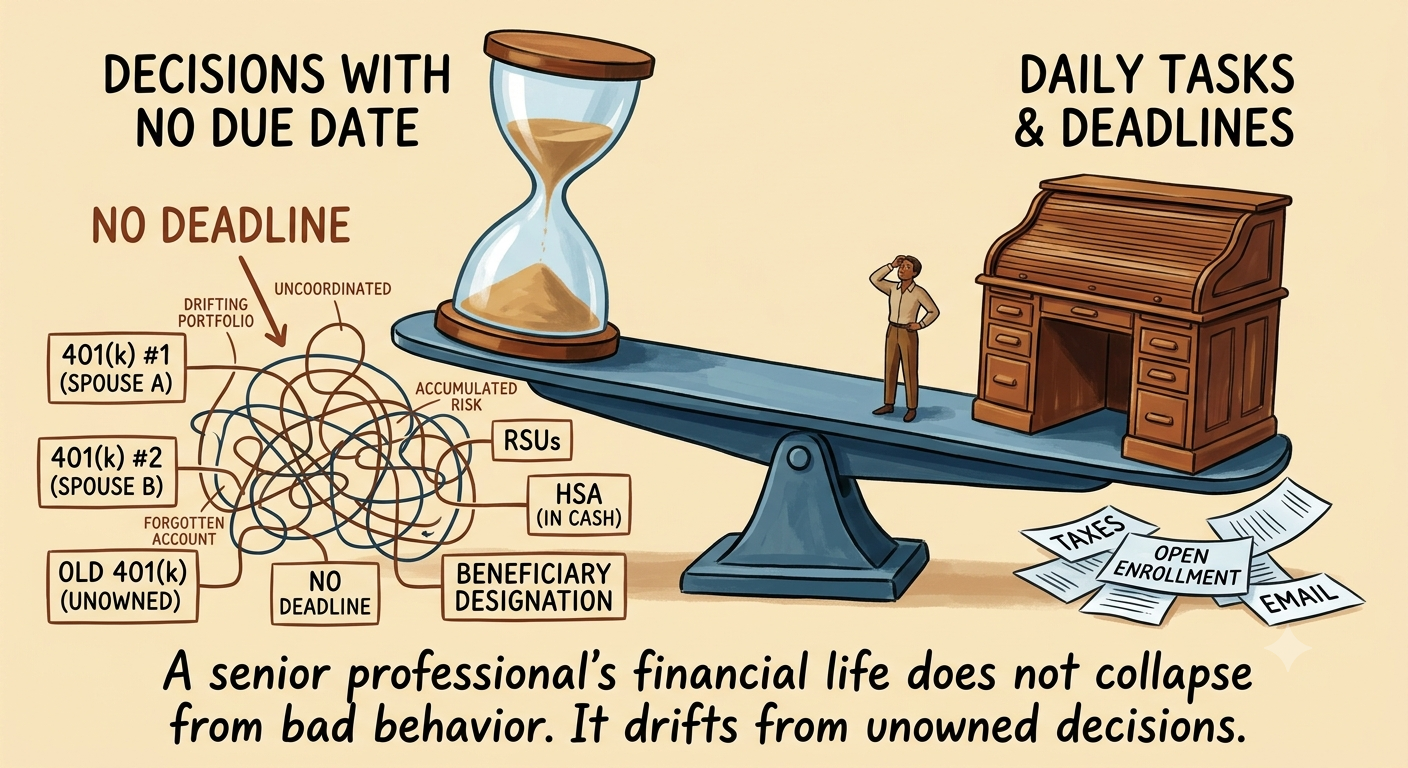
I have started asking a question on first calls with two-income households, and it lands harder than I expected.
Who decided how much stock your family owns?
Not who picked the funds. Who decided the number?
Almost nobody has an answer. And the reason that question stings is that the people I am asking are, by every reasonable measure, doing this right. They have been saving since their twenties. They did not sell in March of 2020. They did not sell in 2022. They are patient, disciplined, long-term people who have quietly built real money while running demanding careers and raising kids.
They have the behavior. That is the part everyone tells them to work on, and they already did it.
It is not enough.
The Portfolio Nobody in Your House Actually Built
Here is how the accident happens.
One spouse starts at a new company. HR hands over a stack of paperwork on day one, and buried in it is the 401(k) enrollment. They pick a target date fund based roughly on the year they think they will stop working. Sensible choice. They set the contribution, and they never open it again.
The other spouse starts somewhere else four years later. Different employer, different plan, different lineup of funds. Same sensible choice. Different funds.
Those two funds are not the same. Different fund companies make different assumptions about how much stock a person should own at a given age and how quickly to dial that back over time. Two people the same age, both sitting in a 2050 fund, can end up in meaningfully different mixes. Neither one is wrong. They were just never designed to be used together, because the fund companies had no idea the other one existed.
Now stack the rest of it on top. The 401(k) from the job before last, still sitting at a custodian neither of you has logged into since the move. The HSA has been parked in cash since 2019 because nobody realized it could be invested. The brokerage account that one of you opened during the pandemic. The RSUs.
Add it all up, and you get a household portfolio that neither person designed. It is not aggressive on purpose. It is not conservative on purpose. It is whatever it happened to add up to. And the number it landed on may be wildly out of step with what their family needs, when they need it, and how much risk either of them could tolerate if it went badly.
I want to be careful here, because this is not a story about people who messed up. They saved. They stayed invested through two genuinely frightening markets. They did the hard part, the part that most people fail. Nobody was watching the whole picture. That is a completely different problem, and no amount of patience fixes it.
Equity Comp Makes the Decision for You
The version of this that costs actual money is equity compensation.
Restricted stock vests on a schedule you do not control. A date arrives, shares land in the account, the company sells some to cover taxes, and the rest sit there. Nobody made a decision. The calendar made it, and you found out by email.
Two things go wrong quietly after that.
The first is the tax gap. The withholding from a vest is typically a flat rate applied to supplemental wages. If your household income is well up the bracket ladder, and for the families I work with, it usually is, that flat rate does not cover the real bill. The shortfall is not dramatic on any single vest. It compounds over four vests a year, then shows up in April, and it feels like a surprise even though it was entirely predictable eighteen months earlier. I have watched people who have never missed a deadline in their professional lives get blindsided by a number they could have seen coming.
The second is concentration. The shares that were not sold to cover taxes stay in the account: one vest, no big deal. Three years of quarterly vests, and now a meaningful piece of your family's net worth is in the same company that writes your paycheck. Your income and your investments are tied to the same set of quarterly results. If the company has a bad year, you find out twice, and the second time is worse because it arrives while you are also worried about your job.
Nobody chose that. It accumulated in the absence of a choice.
The fix here is not sophisticated. It is deciding, in advance, what happens when shares land, and checking whether the withholding actually covers what will be owed. That is not a complicated strategy. It is just an owned decision instead of an unowned one. And I would argue that gap, between owned and unowned, is where most of the money in a household like this quietly leaks out.
The Real Avoidance Problem Is Not What You Think
It would be easy to call all this avoidance, and many people in my business do. The story goes that busy parents are hiding from their money, blaming work, kids, and time, refusing to face the numbers.
I do not think that is true for this group. I think it is condescending and misdiagnoses the problem.
The people I am describing run teams. They manage budgets larger than most small companies. They hit deadlines for a living, under real pressure, with real consequences. They are not afraid of hard numbers. They look at hard numbers all day.
What they avoid is decisions with no due date.
Look at what actually gets done in a household like this. Open enrollment gets done because it has a deadline. Taxes get done because they have a deadline. The mortgage gets paid, the tuition gets paid, the kid gets to the tournament in Grand Rapids by seven in the morning, because all those things have a date attached to them, and this is a household that is extremely good at hitting dates.
Now look at what does not get done. Nobody sends you a reminder about who inherits your 401(k). Nothing forces you to look at both retirement plans in the same window. No calendar invite appears asking whether your household stock allocation is the one you would have chosen if anyone had ever chosen it. There is no forcing function, so it sits. Not for a month. For ten years.
I have seen beneficiary designations still naming a parent who died years earlier, on accounts worth more than most people's homes, belonging to people who manage two hundred employees. That is not carelessness, nor avoidance in any meaningful psychological sense. That is what happens to a decision that nobody put a date on.
A senior leader's financial life does not collapse from bad behavior. It drifts from unowned decisions. And drift is harder to see than collapse, which is exactly why it goes on so long.
The Deadline I Had to Invent
I am not standing outside this problem. I am in it.
This is what I do for a living, and there are still things in my own house that only got handled because I manufactured a deadline for them.
A few years ago, I started counting summers. The triplets graduate in May of 2029. Counting the one we are standing in right now, that leaves three. Three more summers with all of them under this roof, and then the shape of this family changes permanently.
I did not start counting because I am disciplined. I started counting because "be present with your kids" is a decision with no deadline. There is no enrollment window. Nothing forces the issue. No one emails you in November to say the form is due. So, it just quietly does not happen, one week at a time, while I answer one more message and tell myself the season is long.
Theresa gets emotional when either of us says the number out loud, and I understand why. But we keep saying it, because the number is the only forcing function we have. Without a date, the thing I care about most loses every time to the thing with a due date on it. That is not a values problem. My values are fine. It is a structural problem, and it is the exact same structural problem sitting inside those two 401(k)s.
Same failure mode. Different account.
The Two Numbers to Write Down
Open both retirement plans in the same browser window. Yours and your spouse's, at the same time.
Write down what percentage of each one is invested in stocks.
Do not rebalance. Do not change your contribution. Do not make a decision today.
Just find out whether anybody ever picked the number.
Because the quote I keep coming back to says that doing well with money is not about how smart you are, it is about behavior. Patience, control over greed and fear, long-term thinking. I believe that. It is why you have something worth organizing in the first place.
But behavior is the floor, not the ceiling. It is what gets you to the starting line. It is not what runs the race. At some point, somebody in your house has to own the decisions that nobody bothered to put a date on. If that person is not you, and it is not your spouse, then it is not anyone.
And the accounts do not wait for a deadline that never comes.