
The Two Buckets Every Family’s Money Belongs In
There’s a question I find almost impossible to answer cleanly, both about my own money and about the families I work with. Am I being patient, or am I just stuck?
The two look identical from the outside. The patient investor and the stubborn one both hold their position when things get uncomfortable. Both ignore the noise. Both say they’re in it for the long term. One of them is right, and the other is quietly paying for the difference. The hard part is that you usually can’t tell which one you are.
This matters most for families with two-career parents and kids at home than for almost anyone else. You have more moving parts than most people, and far less time to watch them. So things get set once and left alone, and after a few years, you can no longer tell what you’re holding on purpose and what you’ve stopped looking at.
Two buckets
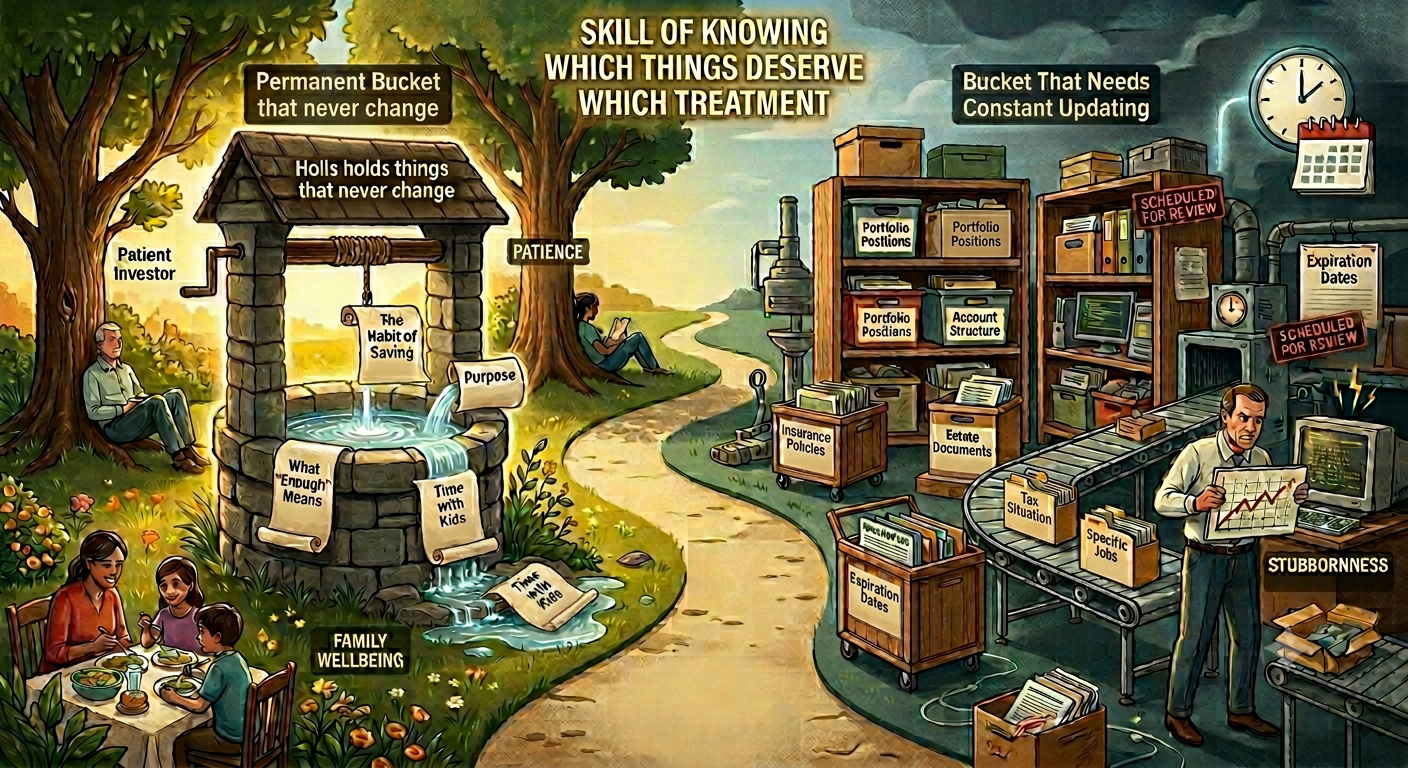
A line from Morgan Housel gave me the cleanest way to sort this. The only way to think long-term well, he wrote, is to know the very few things that will never change, and put everything else in a bucket that needs constant updating. The few things that never change are the candidates for long-term thinking. Everything else has a shelf life.
Most families never do this bucketing. They treat everything as permanent, so nothing ever changes, and the whole financial life slowly drifts out of date. Or they treat everything as up for grabs, so they tinker constantly and never give anything time to work. The skill isn’t patience or decisiveness. It’s knowing which things deserve which.
The cost of getting it wrong isn’t dramatic, which is exactly why it hides. Nobody wakes up to a disaster. It’s slower than that. The disposable things you treated as permanent drift quietly out of date, a year at a time, until the plan you’re running was actually built for a life you no longer live. Meanwhile, the permanent things, the ones that deserved steady attention, get crowded out by whatever happened to be loudest that week. By the time it’s obvious, you’ve lost years you can’t get back.
What belongs in the bucket that never changes
For a family, the permanent bucket is smaller than you’d expect. The habit of saving. What “enough” actually means for your household. The years you have with your kids at home. Your purpose, the reason the money exists at all. These don’t have a shelf life, and they don’t respond to headlines.
These are the things worth being genuinely patient about. Your saving habit shouldn’t swing with the market. What's enough for your family shouldn’t move every time a neighbor renovates a kitchen. The window with your kids is fixed and closing whether you watch it or not. When something lives in this bucket, holding steady is patience, not stubbornness.
Take what “enough” means for your household. It belongs in the permanent bucket, but most families never actually define it, so it never gets to do its job. Without a shared sense of the number, “enough” floats, and it tends to float upward, pulled along by the next promotion, the next neighbor, the next thing you didn’t know you wanted until you saw it. A definition you’ve actually talked through together is one of the few things steady enough to anchor every other decision. Skip it, and there’s nothing in the permanent bucket to hold the line.
So you protect these, and you build everything else around them. That’s the whole point of naming them. Once you know what can’t change, you stop letting it get pushed around by everything that can.
What has a shelf life
Almost everything else belongs in the other bucket. Which positions are in your portfolio. How your accounts are structured. The specific job and the specific benefits that come with it. Your tax situation this year. The number you decided was “enough” ten years ago, before the kids, the bigger house, and the older parents. All of it needs regular updating, and holding any of it too long is stubbornness wearing patience’s clothes.
Insurance is a common one. Families often buy a policy at one life stage, when the kids are small, and the mortgage is huge, and then carry it unchanged for fifteen years into a completely different situation. The decision was right when they made it. It just had a shelf life nobody marked on the calendar.
Estate documents are the same story, often drafted before the kids could drive and never revisited, naming guardians and backups that no longer make sense. None of these were mistakes. They were sound decisions that aged out while everyone was busy living.
The clearest place I see this go wrong is a job change. When you start at a new employer, you make a pile of decisions in your first week: the retirement plan, the contribution rate, where the money gets invested, and then you never look at them again. Those were never meant to be permanent. They were defaults you picked while you were busy learning a new job. Years and a couple of employers later, two retirement plans are running on settings nobody chose on purpose, a brokerage account is drifting on autopilot, and no single person is looking across it all.
That isn’t patience. It’s a shelf-life decision that expired and never got replaced. And the answer isn’t to obsess over it every week, because that moves it into the wrong bucket from the other direction. The answer is to recognize what it is and put it on a schedule for honest updating.
Patient, or just stubborn?
So how do you tell the difference in the moment, when both feel like conviction? The test I use is simple. Ask whether you’re holding it because the thing belongs in the permanent bucket, or because changing it is uncomfortable. Patience has a reason you can say out loud. Stubbornness has an excuse you’d rather not examine.
You can usually hear it in how someone answers a follow-up question. When I ask a family why they’re holding something, and they can walk me through it, what it’s for, how it fits the rest of the picture, when they’d actually change it, that’s patience. When the answer trails off into “we’ve always done it that way” or “it felt risky to touch,” that’s the tell. The position itself might even be fine. But they’re keeping it for the wrong reason, and the wrong reason is what eventually steers them into a genuinely bad decision down the road.
In my own life, naming the permanent bucket reorganized everything. My kids are a few years from leaving home, and that truth doesn’t change and doesn’t negotiate. Once I put it where it belonged, a lot of the disposable stuff, the extra client, the bigger business, got easier to set down. Purpose doesn’t change. Objectives do. I just had to stop confusing the two.
Morgan Housel’s point was that the few things that never change are the only real candidates for long-term thinking, and everything else has a shelf life. Most of the stress I see in families’ financial lives comes from getting that backward, guarding the disposable, and neglecting the permanent. Sort the two honestly, even once, and a surprising amount of the noise goes quiet.