
You Solved the Money Math Years Ago. You Still Can't Stop.
Most of the advice about wanting less is aimed at the wrong target. Drive the older car. Skip the bigger house. Don’t get pulled into the next upgrade. It’s good advice, and for the families I work with, it’s also the easy part. Turning down a nicer car when you already have what you need isn’t really a sacrifice. It’s a preference.
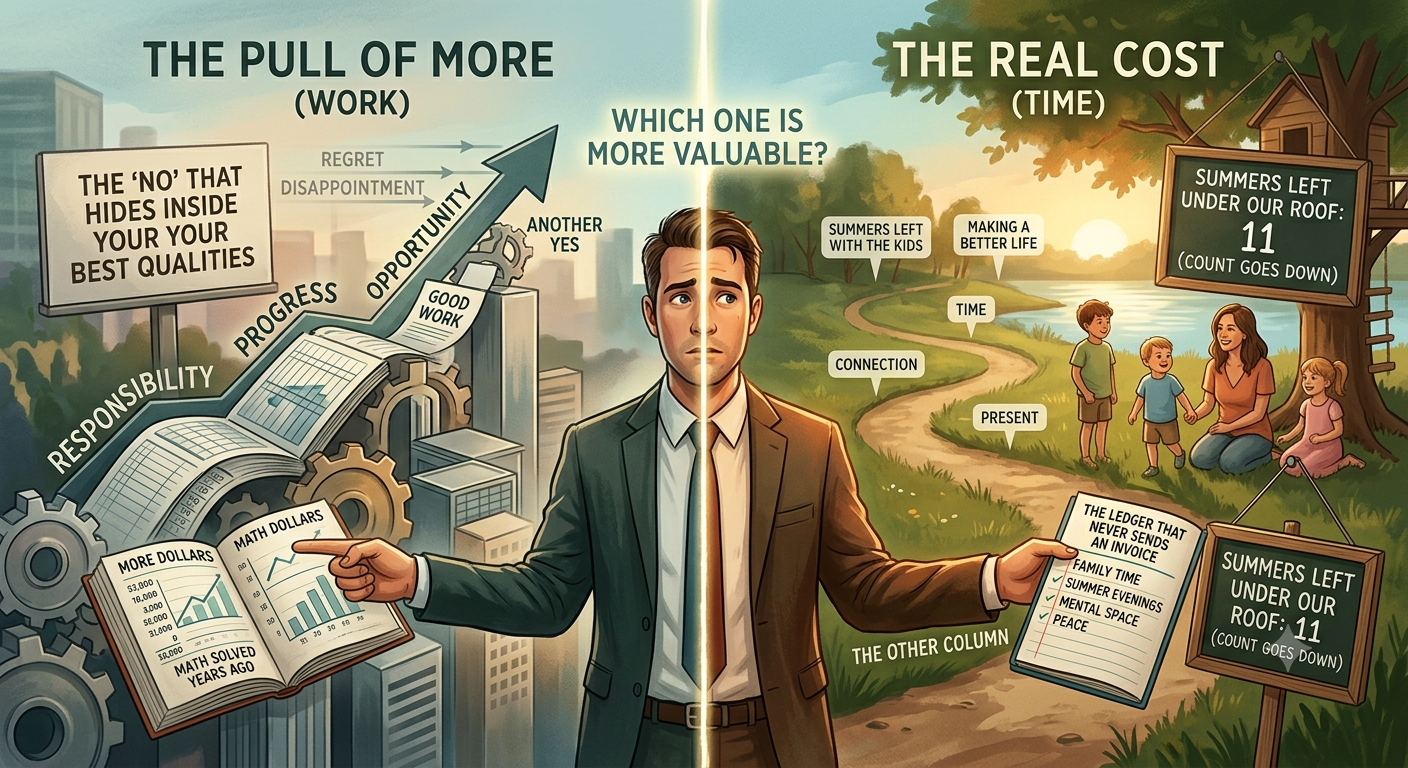
The “no” that actually decides things is a different one, and almost nobody talks about it. It’s the ability to turn down more of the work you genuinely love.
That’s the one I wrestle with. And it’s the one I watch the families I work with wrestle with too, usually without naming it.
The easy no’s and the hard no’s
“An insatiable appetite for more will always push you to the point of disappointment and regret, and that having some ability to deny an extra dollar of work, or a bigger house, or a nicer car, is essential if you want to use money to make a better life. That line is from Morgan Housel's work, and notice that he put “an extra dollar of work” first on that list, ahead of the house and the car. I don’t think that’s an accident.
The house and the car are easy to moralize about, because wanting them can look like greed, and nobody wants to look greedy. But more work doesn’t look like greed. It looks like responsibility. It looks like drive, like providing, like building something worth building. All the things you’ve been praised for your entire career. That’s what makes it the hard no. You can dress it up as a virtue right up until the moment it costs you something you can’t get back.
And it rarely arrives as one dramatic choice. Nobody sits you down and asks whether you’d like to trade a year of bedtimes for a bigger title. It arrives as a hundred small yes’s. The late email. The call you take on the drive home. The project you didn’t need but couldn’t resist. Each one is so small that refusing it feels almost silly. Added up over a few years, they’re the whole thing.
Why this is harder if you’re good at what you do
Here’s what makes this especially sharp for senior-level professionals. You got where you are partly because you’re good at the work and, on some level, because you like it. The promotion, the bigger team, the harder problem, those weren’t burdens you resented. They were things you were drawn to. The work is genuinely rewarding, and you’re genuinely good at it. That isn’t a problem to fix. It’s just what makes saying no to more of it so difficult.
And there’s a mechanical piece underneath the emotional one. When you earn well, the lever is always within reach. You can almost always make more by saying yes to one more thing. Which means “enough” stops being a math problem and quietly becomes a permission problem. The math has been solved for a while. What’s missing is the permission to stop reaching, even when reaching is right there and feels good.
I feel this in my own work. I could grow what I’ve built. There are weeks when the pull to take on more is strong, not because I need to, but because I enjoy the work, I’m good at it, and more of it sounds like progress. The honest part is that the wanting doesn’t disappear just because the math says it can. That’s the appetite Housel is describing. It doesn’t get full on its own.
Underneath all of it runs a quiet story that goes: “I’ll feel settled once I land the next thing. More income, the next rung, the bigger client.” But more rarely changes the feeling, because the feeling was never about the number in the first place. I’ve watched families hit the exact figure they once swore would be enough and wake up the next morning feeling no more settled than before. The number arrived. The permission didn’t. That’s the part the math can’t reach.
The cost is on the other side of the ledger
The trouble with an extra dollar of work is that the cost never shows up on the same page as the benefit. The benefit is immediate and easy to count: more income, more standing, the plain satisfaction of doing something well. The cost lands on the other side of the ledger, in a column that never sends you an invoice. So you book the gain today and pay the bill later, often without realizing a bill was ever run up.
Part of why that gain keeps winning is that it’s the only side with numbers on it. The income shows up on a statement. The standing shows up in a title. The cost has no units. You can’t put a figure on the science fair you half-watched while answering email, or the conversation that never happened because you were still at the kitchen table at nine o’clock. So when the two sit side by side, the one you can measure wins almost every time. Not because it matters more, but because it’s the only one you can see clearly.
At home, Theresa and I keep a number that puts it in stark terms. The count of summers we have left with the kids still under our roof. It’s a small number, and it only goes down. When I’m deciding whether to say yes to more work, that’s the column the cost lands in. Not in dollars. In summers. And summers don’t compound. You don’t get to reinvest the one you missed and earn it back with interest later.
I see the same ledger with the families I work with, just denominated in their own currency. The relocation that made perfect sense on paper and quietly cost them the few years their kids still wanted to spend with them. The promotion that was the right career move in exactly the wrong year to be absent. None of these were greedy people. They were thoughtful people who said yes to good things, one reasonable yes at a time, and only added up the other column once it was already spent.
Keeping the no available
None of this is an argument that ambition is bad, or that you should coast, or that you ought to pretend you don’t love what you do. I love what I do. That’s the entire tension. The point isn’t to want less. It’s to keep the no available, to make sure that “yes to more” is a choice you’re actually making and not a reflex you’ve lost the ability to interrupt.
The next time more is on the table, more work, more opportunity, the bigger version of the thing, pause long enough to look at the other column before you answer. You’ll still say yes plenty. But you’ll be saying it on purpose, with the cost in view, and that is a completely different act from saying it because the appetite never learned how to stop.
The appetite for more runs you toward regret if you let it run unchecked. The families who actually use money to build a better life aren’t the ones who want the least. They’re the ones who keep the ability to say no, especially to the good stuff and the work they love.