
You Have a Coordination Problem, Not an Investment Problem
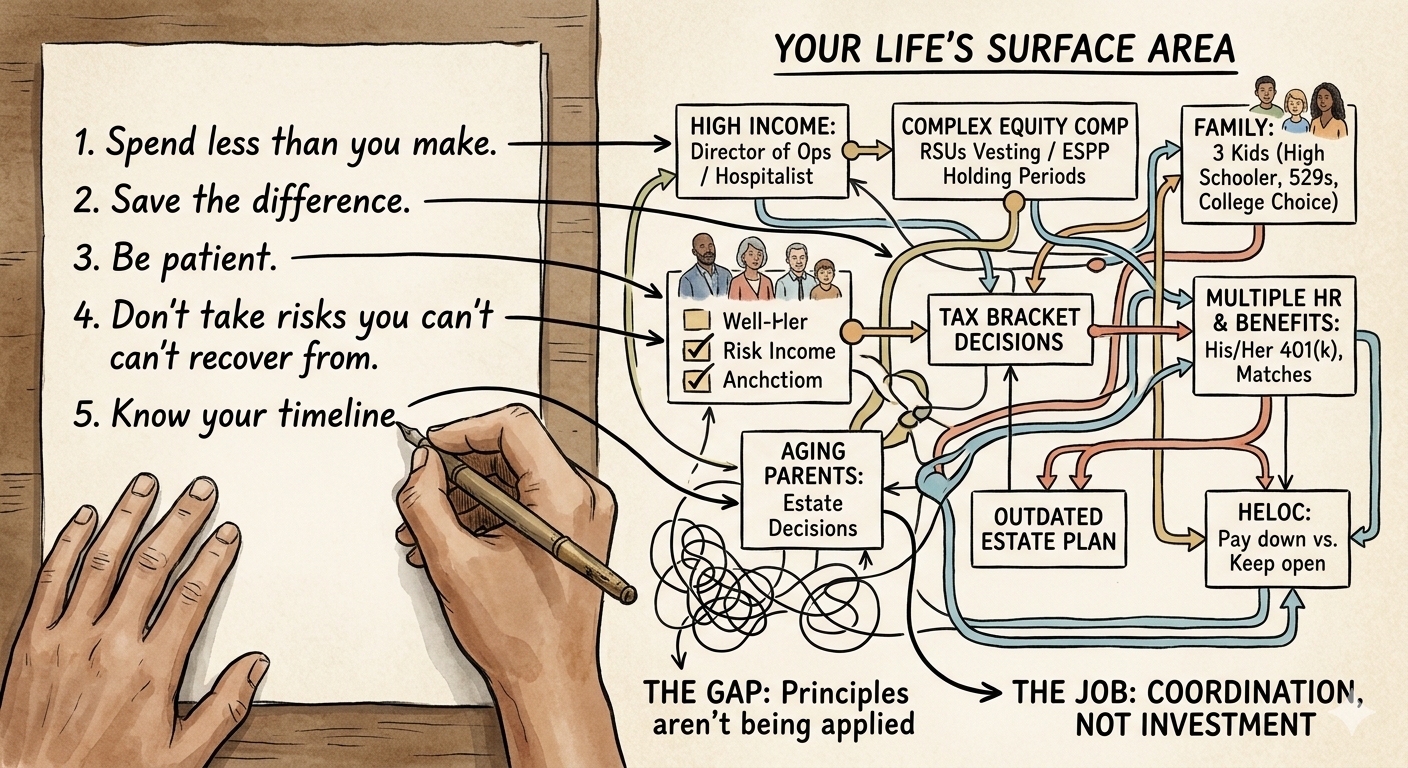
There's something I've been wrestling with for senior professionals. The kind of people I work with at TAMMA, who are running operations at a hospital system, or sitting on the leadership team at a Tier 1 supplier, or building a partner track at a law firm. People who got there by mastering complexity. The promotion came because they could hold the whole picture in their head. The bonus came because they made the complicated thing work.
And then they come into my office and tell me their financial life feels out of control.
The first instinct is to think they need a more sophisticated plan. A better strategy. More tactics. Sometimes that's the answer. More often it isn't.
The Point That Started This
Morgan Housel wrote about this a couple of years ago. He referenced a line from John Reed's book, Succeeding. Reed wrote that when you start to study any field, it looks like you need to memorize a zillion things. You don't. Every field has three to twelve core principles, and everything else is just combinations of those principles. In finance, Housel said, the core is roughly this. Spend less than you make. Save the difference. Be patient. That's perhaps ninety percent of what you need to know to do well. What's taught in college is how to price derivatives. What's popular online is supplements and hacks.
If you're a senior professional with a busy career and a family, the first read of that quote feels like a relief. Simple. Got it.
The second read should bother you. Because the principles really are that simple. And your life still doesn't feel simple. So either you're missing something, or something else is going on.
The Bennetts
I'll give you a real example: a family I worked with, the Bennetts. She's a Director of Operations at a manufacturer. He's a hospitalist: three kids, the oldest just into high school. By any measure, they were doing well. Combined income comfortably north of four hundred thousand. Strong equity compensation on her side. No consumer debt. Plenty of margin.
When we sat down, the husband said something I keep coming back to. He said, " We don't think we have an investment problem. We think we have a coordination problem. He was right.
Here's what their financial life actually looked like. Her 401(k) at her employer, with a company match, neither of them could explain to me without pulling up the plan document. Her ESPP, where nobody was tracking the holding period or the tax basis. RSUs vesting on a schedule that her husband had no opinion about. An old IRA she'd rolled over from a previous employer two jobs ago and basically forgotten. Two 529s for the kids, one funded annually, one funded once and then dropped. A taxable brokerage account that had drifted to twenty-five percent cash because she stopped automatic dividend reinvestment one year ago and never turned it back on. His HSA invested in a target-date fund that didn't align with his time horizon. A HELOC was opened during a renovation, but they hadn't decided whether to pay down or keep it open.
Four professionals touched their financial life. Their CPA filed their taxes. An HR rep at her company handled equity. An advisor at one of the big firms managed the IRA. A loan officer set up the HELOC. None of them talked to each other.
Their question wasn't what I should believe about money. They knew. Their question was: "Is anybody actually steering this?"
That's not a principles problem. That's an application problem.
Principles Are Stable. Your Life Isn't.
The principles in finance are stable. Spend less than you make. Save the difference. Match the time horizon of your money to the time horizon of your need. Don't take risks you can't recover from. Don't pay more in tax than you have to. Stay patient when things get noisy. Spend on what you actually value. You can write seven to ten principles, but they don't update year over year.
What updates is your life.
When you've reached a director or VP role, your financial life has a larger surface area than it did ten years ago. You have equity comp that needs to be exercised, taxed, and reinvested with intention. You have a tax bracket that turns ordinary decisions into meaningful tax decisions. You have a household with two incomes, two retirement plans, two HR departments, and two sets of benefits to coordinate. You have kids approaching college with 529s, scholarships, and a choice about how much to fund versus how much to ask them to borrow. You have parents getting older, and you may need to help with their estate decisions. You have an estate document that hasn't been updated since the second child was born.
The principles haven't changed. The number of places you have to apply them has.
The Trap
Here's what I see happen, especially with senior professionals. Because their work life rewards complexity, they assume their financial life requires equal complexity. So they start hunting for tactics. A Roth conversion ladder. Direct indexing. Donor-advised funds. The mega backdoor Roth. Whether to dollar-cost-average back in after a market drop. These aren't principles. They're implementations of principles. And if you don't know which principle the tactic is serving, the tactic doesn't help you decide. It just gives you another thing to read about, another thing to track, another decision to defer.
The senior professionals I work with don't need a longer list of principles. They need somebody applying the few they already believe in across every account, every employer, every tax year, every kid's college conversation, every estate decision. That's the job. Not better principles. Better application.
A Personal Version
I'll give you a personal version. The principle for me, the one I've held for years, is that the people closest to you deserve at least as much patience as the people who pay you. I would have written that down ten years ago. It hasn't changed.
What has changed is me. The longer I do this work, the more patience I have with client families. I am slower to react. I assume good faith. I let the conversation breathe. I do not interrupt. I sit with discomfort instead of rushing to fix it. And then I get home at six, the triplets are arguing over a phone charger, Mackenzie wants to tell me about her day, Theresa is asking me something I'm only half hearing, and I'm clipped. Short. Not the version of me that my clients met that afternoon.
The principle is clear. The implementation is where I lose.
That same dynamic happens with money. We know we shouldn't be carrying that cash drag in the brokerage account. We know the estate plan is out of date. We know we should rebalance. We know we should have a conversation with our spouse about retirement timing. The principles are clear. The application is where months become quarters and quarters become years.
Try This
Here's a small thing to try this week. Don't make a new financial plan. Don't read another book. Don't sign up for a webinar. Sit down for twenty minutes and write down five to eight financial principles you actually believe. Not what you think you should believe. What you actually believe.
Examples of what these might sound like. I want to retire by sixty. The kids will graduate from college without debt. I want time more than I want a bigger house. I won't take risks I can't recover from. I want my work to feel optional by fifty-five. Whatever yours are, write them down.
Then look at your last six months of financial decisions. The bonus allocation. The 401(k) contribution. The car decision. The college visit. The vacation. The job conversation with your spouse. Ask which principle each decision served.
The decisions you can't match to a principle, that's the gap. The gap isn't your strategy. It isn't your portfolio. Your principles aren't being applied. They're just sitting there.
The Real Job
You don't need more principles. You need to use the ones you have. And often, you need somebody whose job is to apply them across every account, every tax year, every life decision, and every family conversation. That's not the popular work. It's not the work that gets attention online. It's just the work that actually moves a financial life.
The principles are simple. Your life isn't. The work is to make sure the second one is run by the first.