
Three Columns on One Page
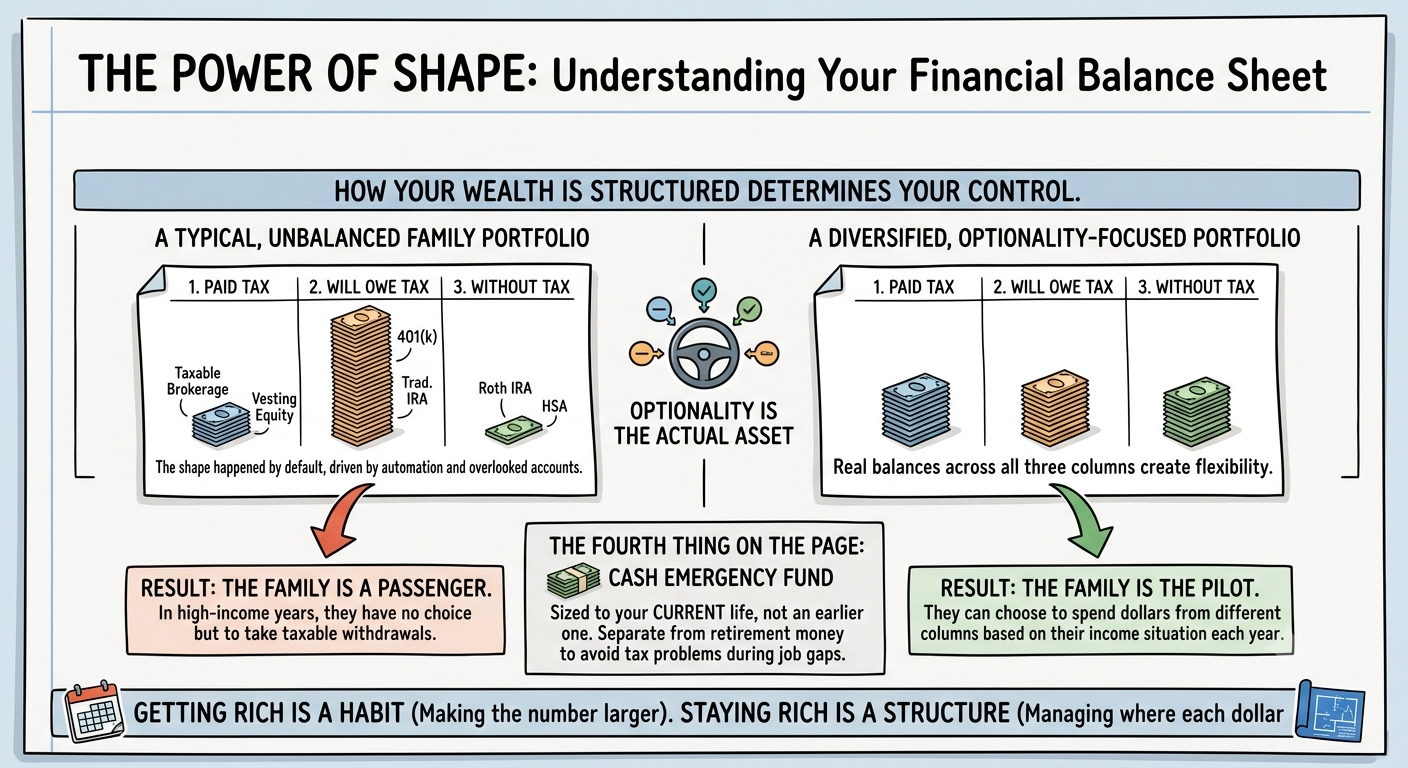
Take a blank page and draw two lines down it, so you have three columns. Label the first one money you have already paid tax on. Label the second column money you will owe tax on when you take it out. Label the third money that comes out without tax.
Then put every account your family owns into one of those columns, with its current balance beside it, and total each column.
It takes about ten minutes if you have the logins handy. What comes out the other side is a picture almost no one in this situation has seen before, because the quarterly statement shows a total and the total hides the shape.
In most families I sit with, one column is enormous, and the other two are small. Sometimes the third one is empty. The people looking at it are not careless with money. They are usually the most disciplined savers I meet. The shape happened anyway.
The Form That Made the Decision
The reason the second column dominates is not a philosophy. It is a payroll deduction.
The 401(k) was set up during onboarding, in the same hour as the health plan and the direct deposit. The contribution came out before the paycheck arrived, so it never felt like a decision. The employer match made it obviously worth doing. Every raise made the contribution larger without anyone touching a form. Twenty years of that produces a very large number, and it produces it without a single further act of intention.
The first column never got the same treatment. A taxable brokerage account requires someone to open it, fund it, and remember to keep funding it. In a family with two demanding careers and kids at home, whatever requires remembering does not happen reliably. So that column got leftovers, and in a busy decade, leftovers are thin.
The third column has its own story. Direct Roth contributions phase out above a certain income level, and most high earners hit that ceiling early in their careers. When the door closed, the conversation ended. Very few people were told that closing that door does not close the question, only that particular entrance to it.
So the shape of the balance sheet was set by which account happened to have automation attached to it. That is worth sitting with for a second. The largest structural feature of a family's wealth was determined by a form filled out in a conference room, and never revisited by anyone whose job it was to revisit it.
Why the Shape Matters More Than the Total
Here is where I want to be careful, because this gets framed as a tax-optimization conversation, and that framing makes it smaller than it is.
Every dollar in the second column is treated as ordinary income in the year it is withdrawn. If nearly everything lives there, the family has no ability to shape a given year. Money is needed, money comes out of the only place it can come from, and the tax consequence follows automatically. The family is a passenger in its own tax return.
With real balances across all three columns, something different becomes possible. In a year with a large income event, a bonus, a big vest, a business sale, the money can come from the first or third column, where the tax was already handled. In a lower-income year, a sabbatical, a gap between jobs, an early retirement, the second column can be tapped on purpose while the rate is lower. The family gets to choose which dollar it spends.
That optionality is the actual asset. Not a lower lifetime tax bill, though that often follows. The ability to respond to a year you could not have predicted twenty years earlier, without every response costing the same thing.
Vesting equity lands in the first column, which is the one place families tend to have real balance, and it usually arrives without anyone noticing that it is the only counterweight they have. That is worth knowing before it gets sold to fund a kitchen or a tuition bill. It is not just money. It is the flexibility side of the page.
The second column, meanwhile, keeps growing on its own. Contributions rise with every raise. The match rises with them. Market growth compounds inside it. So the imbalance does not hold steady over time; it widens, and it widens fastest during exactly the years when a family is too busy to look. Nothing about the arrangement corrects itself.
There is also a version of this question one layer down: which investments sit in which column? Two families can own an identical set of funds and end up in different places over two decades, based solely on where those funds were held. That question has no universal answer, because it depends on balances, time frame, and what the money is eventually for. But most people have never been asked it, which is the part I find worth naming.
The Fourth Thing on the Page
Cash belongs on the page and does not belong in any of the three columns because it serves a different purpose.
Most senior professionals I meet are still carrying an emergency fund sized to an earlier version of their life. It was set when the mortgage was smaller, one income was lower, and there were no tuition payments. It never got resized as the life around it grew, because nothing forces a resize.
That matters most in the scenario it exists for. If a job ends and the only reachable money sits inside a retirement account, then a cash flow problem and a tax problem arrive in the same month. Those two are manageable separately and considerably worse together. Keeping them apart is one of the plainest things a family can do for itself, and it costs nothing but attention.
A Habit and a Structure
Everything that built the second column is worth defending. Save consistently. Take the match. Increase the contribution when the salary increases. Do not touch it during a bad market. That is a decade of behavior most families never sustain, and the families reading this generally have.
But those are skills for making a number larger. The work that follows asks something else. Where does each dollar live? What order does it come out in? How much sits within reach without a tax consequence attached to reaching it. Those are not harder skills. They are simply skills nobody was ever prompted to build, because no onboarding form asks about them and no quarterly statement displays them.
Getting rich and staying rich are different things that require different skills. I used to read that as a warning about risk, about not blowing it. I think it is more ordinary than that, and more useful. The first skill is a habit. The second is a structure. Almost nobody switches from one to the other on their own, because the habit keeps working right up until the day it stops being what matters most.
The page will not tell you what to do. It will tell you the shape of what two decades of good behavior actually built, and the shape is the thing that determines your options from here. Most people have only ever seen the total.