
One Line on Your Vest Statement
The document arrives once a quarter, and almost nobody reads it. It has a company logo at the top, a table in the middle, and a subject line that sounds like a receipt. Shares vested. Shares withheld. Shares delivered. Most of the senior professionals I work with archive it in about four seconds because, on its face, it is good news, and good news usually does not require a second look.
I have started asking for it anyway. Not because something is wrong in most cases, but because that table answers a question people assume has already been answered for them.
The families I sit with in this situation are not careless. They are usually the opposite. Two demanding careers, three kids, both retirement plans funded, both of them holding through market stretches that made other people flinch. They have absorbed the core financial advice of the last thirty years, and they follow it better than most. Save more. Hold longer. Stop tinkering.
That advice is right. It is right about almost everything they own. It is right about the retirement accounts, the brokerage account, the college money. It is right in a way that is hard to overstate, because the families who cannot follow it pay for that failure over and over. The problem is narrower than that, and because it is narrow, it hides.
The Rate Nobody Chose
When a batch of shares vests, the shares themselves are income. The company knows that, so it sells a portion of the batch on your behalf and sends the proceeds in as tax withholding. You keep what is left. It feels handled, because it looks handled. Somebody did math, money moved, a number appeared in your account.
But the rate applied to that sale is a flat rate used by the payroll system for this category of pay. It is not calculated based on your household's actual tax situation. It does not know your spouse's income. It does not know your bonus. It does not know the two other income streams sitting on your return.
For an employee in the middle of the income range, that flat rate is often close enough that nothing dramatic happens. For a dual-income household in a senior role, it frequently sits below the rate at which money is actually taxed. The result is neither an error nor a penalty. It is a gap. And a gap that repeats every vest, in a household where nobody is tracking it against the return, is the kind of thing that turns into an unpleasant conversation in the spring, sometimes several springs in a row.
This is the part I find people are most surprised by, because the withholding looked automatic. Automatic and correct are not the same word. Automatic means a system applied a default. Whether that default fits you is a separate question, and it is one nobody at the company is assigned to ask on your behalf.
Doing Nothing Is Doing Something
The second point of this conversation is duration and concentration that equity compensation brings to the table.
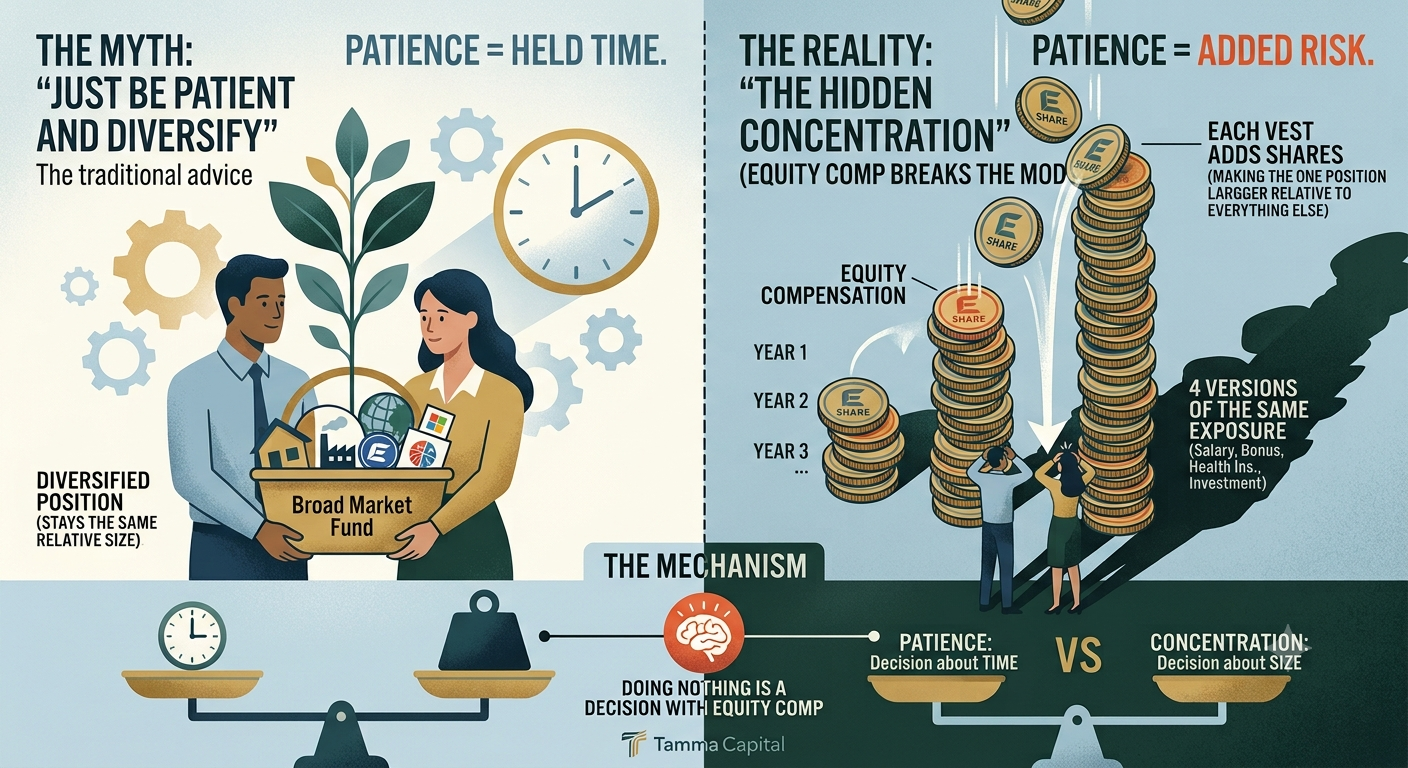
Patience is a decision about duration. It answers the question of how long you hold something, and the answer, for almost every asset a working family owns, is longer than feels comfortable. That is the whole insight, and it is a good one.
Concentration is a decision about proportion. It answers a different question entirely. How much of this do you own relative to everything else on your balance sheet? Patience has nothing to say about that. It was never designed to.
Within equity compensation, every vest adds to the same position. So the family that holds everything, out of genuine discipline, is not standing still. They are accumulating, quarter after quarter, into one company. Six or seven years of that and I have seen a third of a household's investable assets end up in a single stock, arrived at without a single decision anyone would describe as a decision.
Four Versions of the Same Risk
What makes this specific to senior professionals rather than a general investing point is what else is attached to that company. The salary is attached to it. The bonus is attached to it. The health coverage for the whole family is attached to it. And now the largest single holding on the balance sheet is attached to it too.
That is not four risks. It is one risk wearing four different labels. A restructuring at that company does not arrive politely, one item at a time, giving you space to handle each in turn. It arrives all at once, in the same quarter, usually at the worst point in that company's stock price.
I want to be clear about what I am not saying. I am not saying anyone should sell. That decision depends on the family’s full picture, the tax character of the shares, what else is liquid, what the next five years look like, and what the family actually wants. It is not a decision to be made based on an article. It is also, frankly, not a decision that has one right answer.
What I am saying is that it should be a decision. For a lot of the families I meet, it never was. The position was built on a schedule and preserved by virtue, and no one ever sat down and asked whether its size was something they would choose on purpose.
The Ten Minutes
Pull up your most recent vest confirmation, wherever your company keeps it. Find two numbers on it: the total shares that vested, and the shares the company held back for taxes. Divide the second by the first.
That percentage is your actual withholding rate on that income. Write it on a piece of paper. Underneath it, write your marginal tax bracket: two numbers, one page.
If they are close, you have closed the loop and can stop wondering. If they are far apart, you have a specific, answerable question to bring to whoever prepares your return, which is a much better position than a vague sense that something might be off.
The reason I keep coming back to this exercise is not the tax. It is what the exercise does to the second problem. You cannot look at that page and continue to think of the shares as something that happens to you.
Once the number is written down, the position becomes something you are choosing to hold, at a size you have now seen. Patience is still the right instinct. It just works better when you know what you are being patient with.