
New Job, Old Settings
A friend called me a few months into a new role. Bigger title, and the offer letter showed a number a little higher than the one he left. He felt good about it. He had every reason to.
Then his first full paycheck landed, and it was smaller than he expected. He could not figure out why.
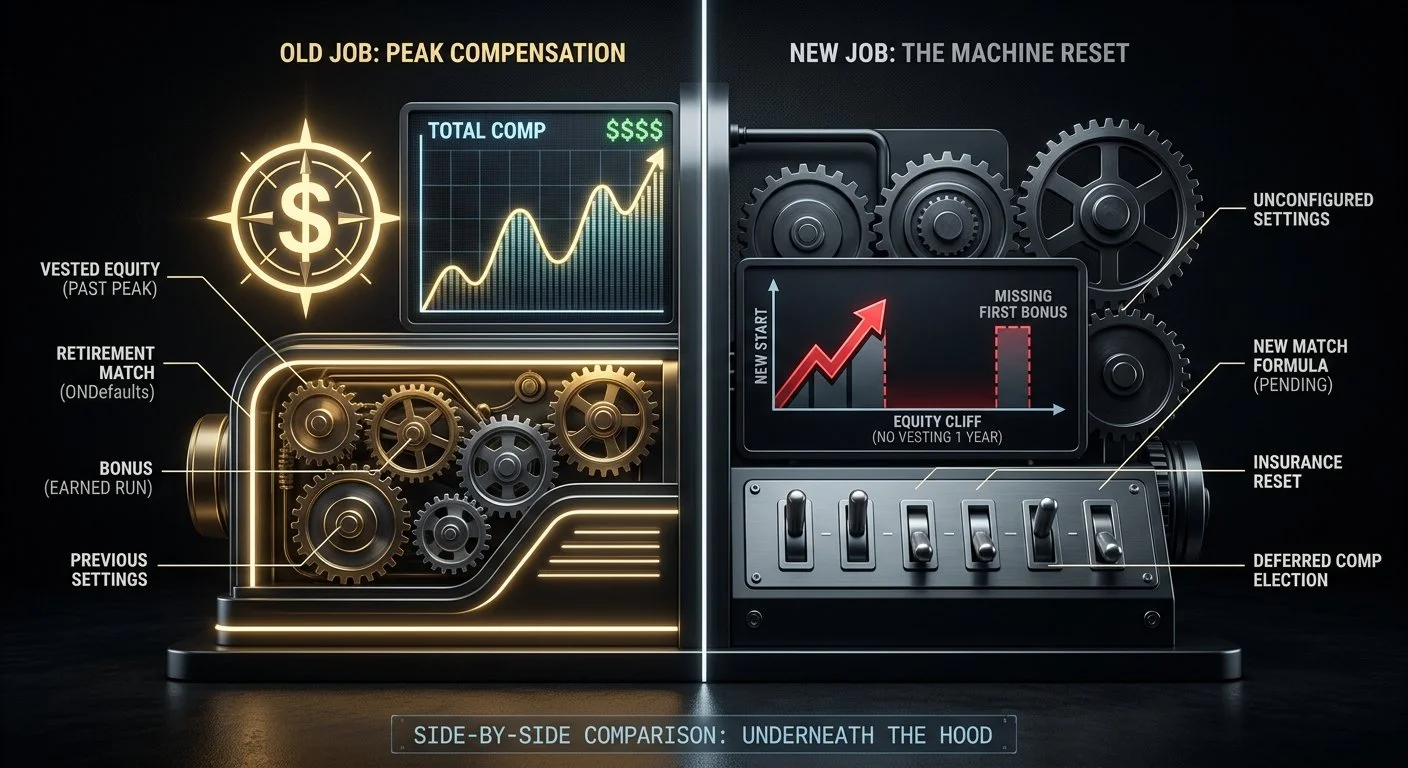
Nothing was wrong. His new employer's match kicked in on a different schedule. The bonus he had been counting on at the old place did not come with him. The equity that used to vest every quarter had stopped, and the new grant would not start paying for a year. On paper the two jobs looked the same. Underneath, they ran on completely different machinery.
The One Part That's Easy to Compare
I see this more often than people would guess. A capable person changes jobs, negotiates the headline number hard, and assumes the rest of the package comes along with it. It does not. The paycheck is the single piece of compensation that lines up cleanly side by side. Everything else, the match formula, the vesting calendar, the deferred comp election, the insurance reset, the timing of the first real bonus, is built differently at every company. Almost nobody puts those pieces next to each other before signing. Negotiations focus on the one number everyone can see, and the parts that quietly shape the next few years get waved through.
The families I work with are good at what they do. That is usually why the offer came in the first place. What trips them is not the new role. It is a quiet assumption that the new seat will behave like the old one, because the old one worked so well. The number kept climbing there, so the number should keep climbing here. That assumption feels like confidence. It is closer to a blind spot.
The Number Was Never Only You
Good luck is easy to ignore when you succeed. This line from Morgan Housel's work is one I re-read recently, and it applies to this exact situation.
The wealth someone builds at a company over eight or ten years is not all skill. Some of it was a good run. The stock had a stretch. The sector was hot. The bonus pool was full three years running. That person worked hard and earned their seat, and they also caught a wave they did not create. Both things are true at once. But when the balance grows, the mind reaches for the simpler version. I did this. My earning power did this.
That simpler story is the expensive one. If you believe the number was all you, you assume you can reproduce it anywhere. So you anchor your life to the peak. The mortgage, the cars, the tuition you quietly committed to, all sized to a total compensation figure that one specific company, in one specific window, happened to produce. Then you carry that figure to a machine that is built differently and wait for it to give you the same output.
What Actually Resets
Here is what moves when you change employers, because this is the part that never makes it into the offer conversation. Read it slowly, because each line is a decision someone is about to make by default.
The retirement match is rarely the same. One company matches dollar for dollar to a point and makes it yours right away. The next matches on a formula and makes you wait years before the match is fully yours. Leave before that point and you leave behind money you had already counted as yours.
Equity is the sharpest reset. Vesting at the old place stops the day you leave, and anything unvested usually goes with it. The new grant almost always has a waiting period before the first tranche, so there is often a gap, sometimes a full year, where the equity income you had grown used to is not there. Nobody feels wealthy during that year, no matter what the net worth statement says.
Deferred compensation quietly causes the most trouble. If you had a plan at the old employer, leaving can change how and when that money comes back to you, and the tax year it lands in is not always the one you would have chosen. The new plan, if there is one, has a short election window that usually cannot be undone. Miss it and you wait a year to take part.
Then the smaller pieces stack. The insurance deductible resets midyear, so you pay it twice in one calendar year. The health savings rules change. The first bonus at the new place comes with a waiting period, while the last bonus at the old place may have walked out the door the day you did.
None of this is hard. That is the part worth saying plainly. Each of these decisions is simple on their own. What people lack is not the ability to make them. It is one uninterrupted hour to set the old package and the new package next to each other and see where they differ. Most people never take that hour, because the offer felt like the finish line, the paycheck looked right, and they were already busy learning the new role. So the package runs on defaults nobody chose, and the assumptions from the last machine keep steering decisions about this one.
I went through my own version of this when I left the corporate world to build my firm TAMMA. I had spent two decades inside companies with a match, a plan, and a structure I never had to think about. It ran quietly in the background. Walking away meant every one of those pieces became mine to rebuild. I learned fast how much I had taken for granted, how much of the old comfort had been the machine running where I could not see it. I was not sharper about this than the people I work with. I just had no choice but to look.
Tell the New Machine What You Want
A job change is one of the few moments when the entire financial picture moves at once. It is also the moment people examine it the least, because the new title feels like an arrival when it is really a reset.
The point is not to be modest about what you have built. You did the work. You showed up on the hard days. But some of that number was a wave you caught, and pretending it was all you is exactly what makes you assume the next seat will hand you the same thing on the same terms. It will not. The paycheck might match. The machine underneath is new, and it is waiting for you to tell it what you want, using the settings you actually chose this time instead of the ones you inherited from a run that is already over.
Before your next move, or right after your last one, do this. Put the old compensation package and the new one side by side. Go line by line: the match formula and its vesting, the equity schedule and any cliff, the deferred comp trigger, the insurance reset, the timing of your first real bonus. Mark the three you never actually re-decided. Then block one hour on the calendar to decide them.