
Your Biggest Financial Risk Isn't the Market
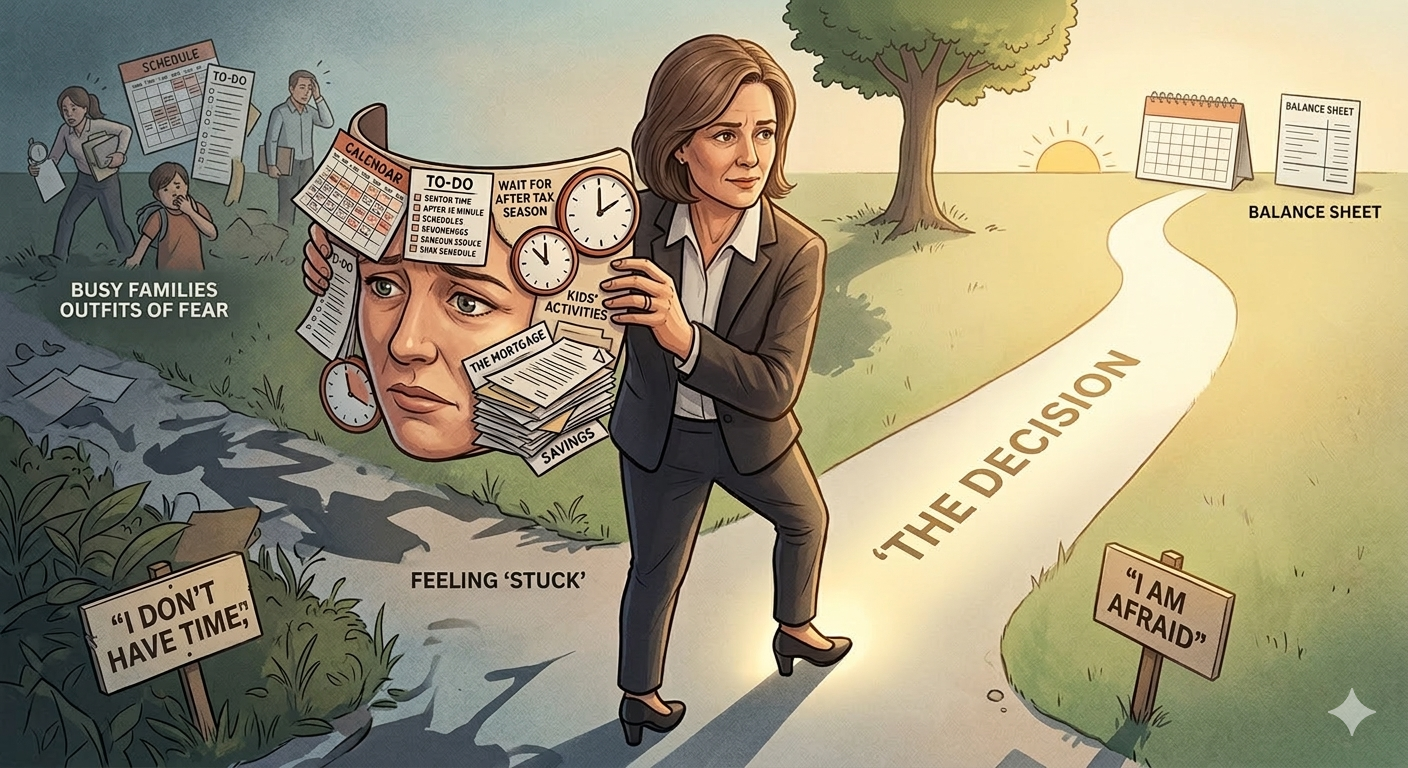
A few weeks ago, I had a conversation with a client I've worked with for years. Smart, successful, completely on top of their financial life in terms of the mechanics. But they'd been sitting on a decision for over a year. Not a complicated one. Not one that required more data or analysis. Just a decision that required them to commit.
And when I asked what was holding them back, they gave me a list. Work has been crazy. The kids' schedules are impossible. They needed to talk to their spouse again. They wanted to wait until after the holidays, or after tax season, or after summer.
All reasonable. All true, probably. But none of them was the real answer.
The real answer was fear. And I think they knew it. They didn't want to say it out loud.
What I See in My Office
I see this constantly in my Family Office at TAMMA. When people come into my office for the first time, I can feel the tension before they even sit down. They're afraid of what they're going to find out. They've built up this image in their heads of how bad things might be, how far behind they are, how much they've screwed up over the years by not paying attention.
And here's the thing: it's rarely as bad as they think. The numbers are the numbers. We can work with numbers. What's harder to work with is the fear that kept them from looking at those numbers for five, ten, or fifteen years.
This isn't unique to financial planning. I spent twenty years in the corporate world before starting TAMMA. CFO roles, operations, and managing teams. I watched people talk about making changes for years without ever making them. Updating their resume. Reaching out to that recruiter. Having the hard conversation with their boss. Starting the side project they'd been thinking about since their kids were born.
The roadblocks were always real. The kids' activities. The mortgage. The spouse's job situation. The economy. The timing.
But underneath all of that was fear. Fear of the unknown. Fear of failure. Fear of finding out they weren't as good as they thought, or that they'd missed their window, or that the thing they'd been dreaming about was actually just a fantasy.
My Own Version of This
I'm not immune to this. When I walked away from corporate life to start TAMMA, I had every logical reason to stay. Good salary. Benefits. Stability. Four kids, including triplets who were still young. Theresa had her own career to manage. The responsible thing was to keep my head down and collect the paycheck.
But I was miserable. And I'd been miserable for a while. And I kept telling myself it wasn't the right time to make a change, that I needed to wait until the kids were older, until we had more saved, until some external condition was different.
What I was really doing was being afraid. Afraid that I'd fail. Afraid that I'd regret it. Afraid that I'd look back and wonder what I was thinking, walking away from something stable to bet on myself.
The roadblocks I named were real. They just weren't the real reason I wasn't moving.
Fear Doesn't Go Away
Here's what I've learned from sitting with families through job losses, deaths of parents, divorces, and every other kind of life transition: fear doesn't go away. You don't overcome it and then operate from some fearless place for the rest of your life. It's always there. The question is whether you let it drive your decisions or whether you make decisions anyway.
For busy parents, this is especially tricky. Because we have legitimate constraints. We don't have margin. Our schedules are genuinely insane. When you're trying to get four kids to three different activities in the same evening while also making sure someone eats something that isn't exclusively carbohydrates, it's easy to say you don't have time to think about the bigger questions.
But that's exactly how years slip by. You keep your head down, you manage the chaos, and then one day you look up and realize you've been stuck in the same place for a decade. Not because you couldn't move, but because you were afraid to.
Fear Wearing a Reasonable Outfit
The families I work with are good at disguising fear as logistics. It sounds like "we need to wait until the bonus comes through," "let's revisit this after the school year ends," or "I want to get a few more data points before we decide." And sometimes those are legitimate reasons to pause. But often, it’s fear wearing a reasonable outfit.
The same thing happens with reaching out to someone like me. I know how much courage it takes to schedule that first meeting. People tell me they'd been thinking about it for months, sometimes years, before they finally sent the email. Not because they didn't know they needed help. Because they were afraid of what they'd find out, or afraid of being judged, or afraid of giving up control.
What I try to tell people is that the fear is normal. Everyone who walks through my door feels it. The difference between the people who are stuck and the people who aren't isn't that the second group figured out how to eliminate fear. It's that they decided to act anyway.
The Value of Naming It
I'm not here to give you a five-step process for conquering fear. I don't think it works that way. Fear is individual, personal, and often deeply rooted in experiences you might not even consciously remember.
But I do think there's value in naming it. In being honest with yourself about what's really going on.
Because when you say "I don't have time," you can argue with that forever. You can optimize your calendar, delegate tasks, and wake up earlier. You can treat it as a logistics problem and spend years trying to solve it without ever making progress.
But when you say "I'm afraid," something shifts. Now you're dealing with the actual obstacle. Now you can ask yourself what, specifically, you're afraid of, and whether that fear is based on something real or something imagined, and whether the cost of staying stuck is greater than the cost of moving forward into uncertainty.
What's Really Stopping You?
I've been an advisor for over two decades now. I've seen what happens when people let fear win, and I've seen what happens when they don't. The people who don't aren't braver, smarter, or more capable. They've just decided that the thing on the other side of the fear matters more than the fear itself.
That's what I want you to think about this week. Not how to eliminate the roadblocks, because some of them are real, and you probably can't eliminate them anyway. But what's actually underneath them.
What have you been wanting to do? Start a business? Update your resume? Have a hard conversation? Finally sit down and look at where you actually stand financially?
And what's really stopping you?
If the answer is a specific logistical problem, great. Solve it and move forward.
But if the answer is fear, at least you're being honest. And honesty is where change starts.
Money is a number. Enough is a story. Make sure you're writing your own.