Running on Fumes at the Kitchen Table
Do you ever notice that you’re a completely different person at work than you are at home?
Not in the obvious ways. Not the “professional versus casual” difference. I mean the deeper thing. The patience difference. The way you can sit in a two-hour strategy meeting, absorb competing opinions, hold tension without reacting, navigate a difficult conversation with a direct report, and stay perfectly composed. And then walk through your front door forty minutes later and lose your composure because your spouse asks about the spending plan.
There is a concept I’ve read by Morgan Housel, which constantly stays with me: “Save like a pessimist and invest like an optimist. Plan like a pessimist and dream like an optimist. Those can seem like conflicting skills. And they are.”
Most people read that and think about asset allocation. And they’re not wrong. But I think there’s a bigger version of this idea hiding underneath the financial concept, one that hits closer to home for every senior professional I work with.
Holding two opposite things at the same time is a skill. And skills cost energy.
The Confession I Didn’t Plan to Make
Here’s something I need to be honest about. As I’ve gotten more experienced in my practice, I’ve become noticeably more patient with my TAMMA families. Families come to me scared. They want to know if they’ll be able to afford college for multiple kids. They want to know if they should sell everything when headlines get loud. They want someone to tell them it’s going to be okay.
I’ve gotten better at that. Sitting in the uncertainty with them. Not rushing to fix. Letting a conversation unfold at its own pace.
But at home? With Theresa and my four kids? I’ve noticed the opposite. My patience has gotten shorter. Theresa will ask me something about our own planning, and I’ll catch myself being dismissive. The same question I’d handle with care for a client, I can barely tolerate from my own wife.
I don’t fully understand why. But I think it’s connected to what Housel is describing. The ability to hold opposing forces at once, fear and hope, caution and confidence, pessimism and optimism, is not unlimited. You can run out. And most of us run out before we get home.
What This Looks Like at the Kitchen Table
Let me tell you about a family I’ll call the Bennetts. (Names have been changed.) She’s a Director of Operations at a regional health system. He’s a senior engineering manager at a tier-one automotive supplier. Combined household income over $350,000. Two kids under ten.
Both are sharp, capable people. She manages a multi-million dollar operating budget. He leads a team of 40 engineers. They solve complex problems all day.
But when I sat down with them for the first time, here’s what their financial picture looked like: two employer 401(k) plans, both on autopilot since enrollment. A brokerage account from his first job that hadn’t been reviewed in years. Some deferred compensation, she wasn’t sure how to think about. A CPA who prepared their return every April but never discussed planning opportunities throughout the year. And a previous advisor who managed the brokerage account but had no visibility into the 401(k)s, the deferred comp, or the tax situation.
Five financial relationships. Zero coordination.
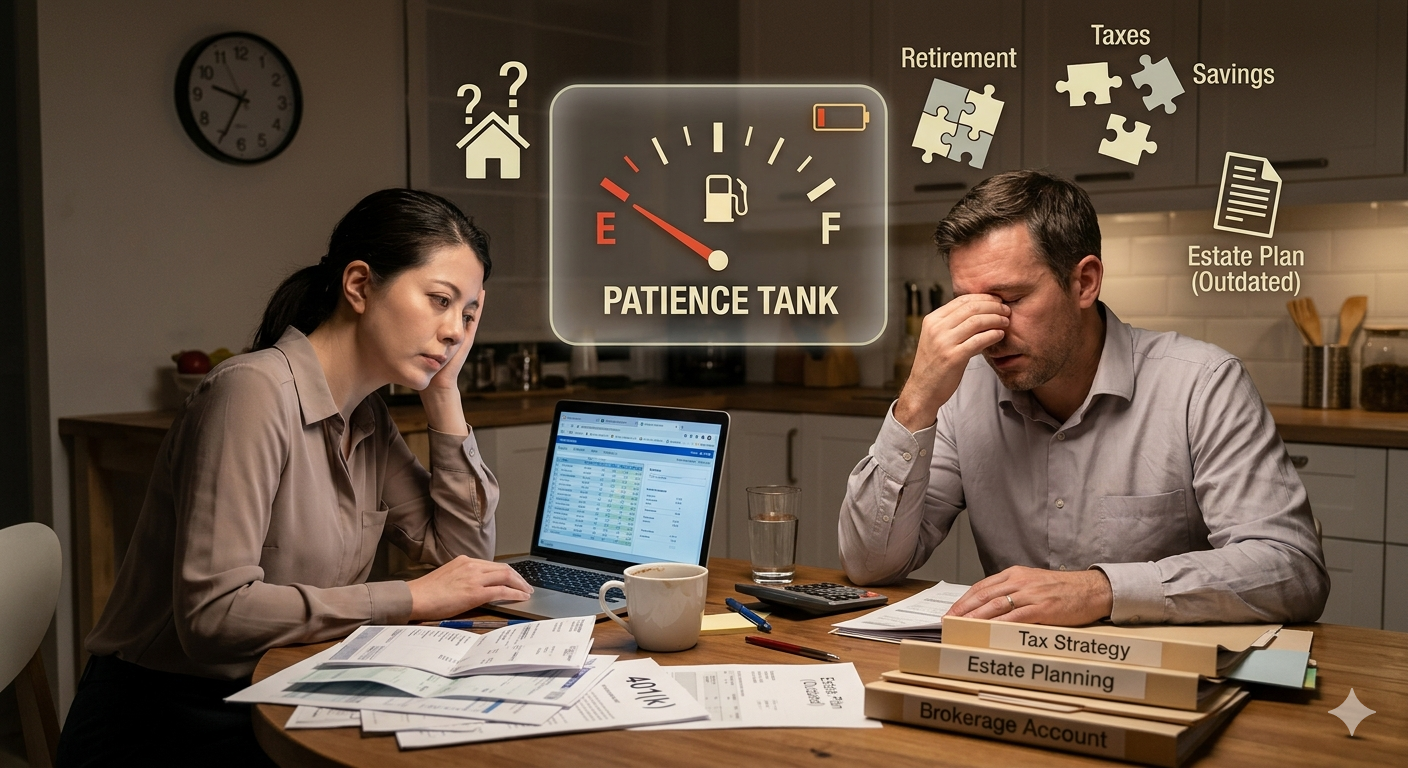
Neither of them was irresponsible. They weren’t ignoring their finances because they didn’t care. They were ignoring the coordination because they were exhausted. By 9 PM, after the kids were finally in bed, they didn’t have the patience left to sit across from each other and connect the dots.
So the 401(k)s stayed on autopilot. The brokerage drifted. The CPA filed but didn’t plan. And two people who are paid to hold complexity for a living couldn’t hold their own.
The Fear Nobody Names
Here’s what I’ve learned after working with families for over two decades: the fear that drives most of my conversations isn’t market fear. It’s coordination fear. The quiet, background anxiety that nobody is seeing the whole picture.
You’re making contributions. You’re earning well. You’ve got accounts and advisors and a CPA. But none of them are talking to each other. And you don’t have the bandwidth to be the one connecting it all.
This is the shadow side of Housel’s idea. The pessimist in you sees all the ways things could go wrong, and that instinct keeps you saving. The optimist in you believes the long-term trajectory is up, and that keeps you invested. But at home, you’ve collapsed into a third mode. Not pessimist. Not optimist. Just empty.
That’s where the financial plan goes uncoordinated. Not from bad judgment. From depletion.
If you’re a Director of Nursing who manages a staff of 200 and then comes home to unreviewed beneficiary designations and a 401(k) you set up six years ago, this isn’t a knowledge gap. It’s a patience gap. If you’re a VP of Engineering who can hold a complex project timeline in your head but can’t bring yourself to figure out whether your family’s tax strategy makes sense across both incomes, that’s not incompetence. That’s exhaustion.
What It Costs
The cost of financial autopilot isn’t dramatic. It’s quiet. It’s the tax-loss harvesting opportunity nobody noticed. The 401(k) allocation hasn’t been updated since your last job. The estate documents still name an executor who moved to another state. The retirement projection built on assumptions from three promotions ago.
None of these is a crisis on any given day. But they compound. And by the time you look up from the daily chaos, years have passed, and you realize nobody was steering.
Before your next financial conversation at home, any conversation that requires you and your spouse to hold complexity together, check your patience tank. Am I showing up with the same measured, thoughtful presence I’d bring to a meeting at work? Or am I running on what’s left?
If the answer is fumes, reschedule. Not because it doesn’t matter, but because it matters too much to handle when you’re depleted.
And if you realize that your financial life is running on autopilot, that your 401(k)s, tax strategy, estate plan, and investment accounts are all floating independently with no one holding the complete picture, pay attention to that. Not next quarter. Now. Because the cost of nobody steering isn’t visible until it’s expensive.
Save like a pessimist. Invest like an optimist. But save some patience for the people at the kitchen table. They need your best, not your leftovers.
Money is a number. Enough is a story. Make sure you’re writing your own.